

Ultimate Guide to Prepare Free Oracle 1z0-931-23 Exam Questions and Answer
Pass Oracle 1z0-931-23 Tests Engine pdf - All Free Dumps
NEW QUESTION # 13
According to Oracle documentation, it is a best practice when planning and instituting Access Controls for your Autonomous Dedicated environment regarding Subnets, Compartments and User Groups.
Which statement is true?
- A. Create a separate VCN that contains only public subnets
- B. Create at least 2 of each resource
- C. Only 1 Subnet and 1 Compartment are allowed, multiple Groups highly advised.
- D. Only 1 of each is allowed to be allocated per environment.
Answer: B
Explanation:
Refer to Best Practices When Planning and Instituting Access Controls section in the https://docs.oracle.com/en/cloud/paas/autonomous-database/atpfg/plan-and-create-access-constraints1.html#GUID-ED48C3D3-FC0F-41D5-882A-FC2D916FD6AA
https://docs.oracle.com/en/cloud/paas/autonomous-database/atpfg/plan-and-create-accessconstraints1.Html
NEW QUESTION # 14
Which statement is FALSE regarding provisioning an Autonomous Database and configuring private endpoints with security rules to allow incoming and outgoing traffic to and from the Autonomous Database Instance?
- A. A stateless ingress rule is created to allow connections from the source to the Autonomous Database instance
- B. The destination port range is set to 1522
- C. The IP Protocol is set to TCP
- D. The source is set to the address range you want to allow to connect to your database
Answer: A
NEW QUESTION # 15
Which two actions are available to perform when an Autonomous Database is stopped?
- A. Change administrator password
- B. Update Network Access
- C. Update License Type
- D. Start
Answer: C,D
NEW QUESTION # 16
Which two statements are true about Oracle Cloud Infrastructure (OCI)?
- A. An OCI region is a localized geographic area, and an availability domain is one or more data centers located within a region
- B. Because availability domains do not share infrastructure, such as power or cooling, or the Internal availability domain network, a failure at one availability domain within a region is u likely to impact the availability of the there within the same region
- C. A single fault domain can be associated with multiple regions and availability domains
- D. Regions are dependent on other regions and must be located within five thousand kilometers of each other
Answer: A,B
NEW QUESTION # 17
Which statement is FALSE about the Catalog tool?
- A. Impact shows the entities that depend on the source.
- B. You can view the data definition of an entity.
- C. You can limit the display of entities to only those with certain names, schemas, types, or applications by entering values in the Search field.
- D. You can delete an entity from the Autonomous Database via the Catalog tool.
Answer: D
Explanation:
The Catalog tool is a built-in feature of Autonomous Database that provides an easily searchable inventory of all the objects in, or accessible from, the database, such as schemas, tables, views, columns, analytic views, files on cloud object storage, and more1. However, the Catalog tool does not allow you to delete any entity from the database. You can only view the details, lineage, and impact of an entity using the Catalog tool2. To delete an entity from the database, you need to use other tools such as SQL Developer Web or APEX3. Reference:
Manage Automatic Indexing on Autonomous Database - Oracle Help Center.
Introducing the Autonomous Database Catalog - Oracle Blogs.
Oracle Autonomous Database - Oracle Autonomous Database.
NEW QUESTION # 18
Which statement is NOT correct when using Automatic Indexing on Autonomous Data Warehouse?
- A. It is enabled by default.
- B. Process includes identify candidates, create invisible auto indexes , verify with implement if performance improved and delete unused.
- C. The indexing feature is implemented as an automatic task that runs at a fixed interval.
- D. You can use the dbms_auto_index package to report on the automatic task and to set your preferences.
- E. You can control behavior at the statement level using the use_aoto_indexes or NO_USE_AUTO_INDEXES hints.
Answer: A
Explanation:
https://docs.oracle.com/en/cloud/paas/autonomous-database/adbsa/autonomous-auto-index.html#GUID-D51A4F85-3AE5-4B7D-9B27-32CEDE8DBD79 - Auto Indexing is disabled by default in Autonomous Database
NEW QUESTION # 19
What is the role of a Fleet Administrator in Autonomous Database (ADB) on Dedicated Infrastructure deployments?
- A. Fleet Administrator defines and gains access to the ADMIN administrative user account for the database.
- B. Fleet Administrators are responsible for patching and backups of all container databases.
- C. Fleet Administrators create, monitor and manage Autonomous Databases.
- D. Fleet administrators create, monitor and manage Autonomous Exadata Infrastructure and Autonomous Container Database resources.
Answer: D
Explanation:
https://docs.oracle.com/en/cloud/paas/autonomous-database/adbah/index.html#articletitle
https://docs.oracle.com/en/cloud/paas/autonomous-database/atpfg/index.html
NEW QUESTION # 20
Which subset of services is offered via OCI-CLI (command line interface) for Autonomous Database (ADB) via calls made to the OCI APIs?
- A. Create, Get, List, Stop, Restore
- B. Create, Query, List, Stop, Restore
- C. Create, Query, Update, List, Start
- D. Start, Delete, Update, Query, Stop
Answer: A
Explanation:
OCI-CLI is a command line interface tool that can be used to interact with Oracle Cloud Infrastructure services, including Autonomous Database. The OCI-CLI provides commands for creating, getting, listing, stopping, and restoring Autonomous Database instances. These commands are documented in the autonomous-database section of the OCI-CLI Command Reference1. Reference:
Command Line Interface (CLI) - Oracle Help Center, section "autonomous-database".
autonomous-database - OCI CLI Command Reference 3.34.0 documentation - Oracle.
NEW QUESTION # 21
Which two optimizations are different between Autonomous Data Warehouse and Autonomous Transaction Processing?
- A. Index Storage
- B. Data Organization
- C. Backup Retention
- D. Undo Management
- E. Memory Usage
Answer: A,E
NEW QUESTION # 22
Which statement is true when you provision an Autonomous Database using the cloning method?
- A. When cloning an Autonomous Database, Oracle Machine Learning workspaces, projects, and notebooks of the source database are cloned to the new database.
- B. A clone database source can be from a point-in-time backup that is less than 2 hours old.
- C. After an Autonomous database is created using a clone, the network access option can be changed.
- D. A clone database source can be a running database instance.
Answer: D
Explanation: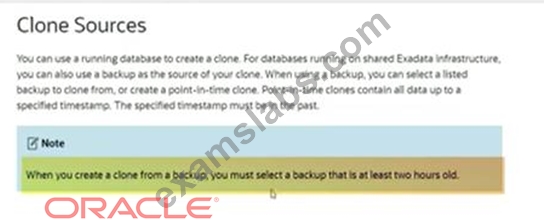
NEW QUESTION # 23
Which workload type does the Autonomous Database on dedicated infrastructure service currently support?
- A. Autonomous Data Warehouse only
- B. Autonomous Transaction Processing only
- C. ATP and ADW
- D. Hybrid Columnar compression
Answer: C
NEW QUESTION # 24
Which command should you issue to enable application continuity on 0 Shared Infrastructure?
- A. exec dbms_cloud admin.enable_app_cont('<cservice_name>');
- B. alter session set application_continuity-true
- C. alter database set application_continuity=true
- D. alter system set application_continuity=true
Answer: A
NEW QUESTION # 25
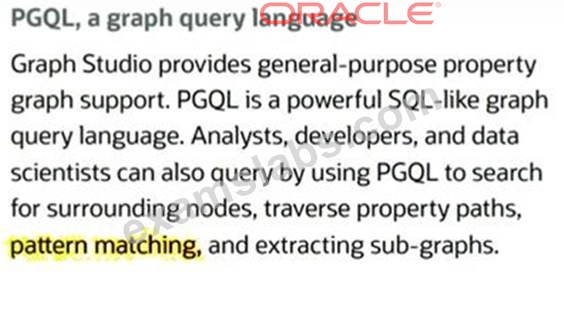
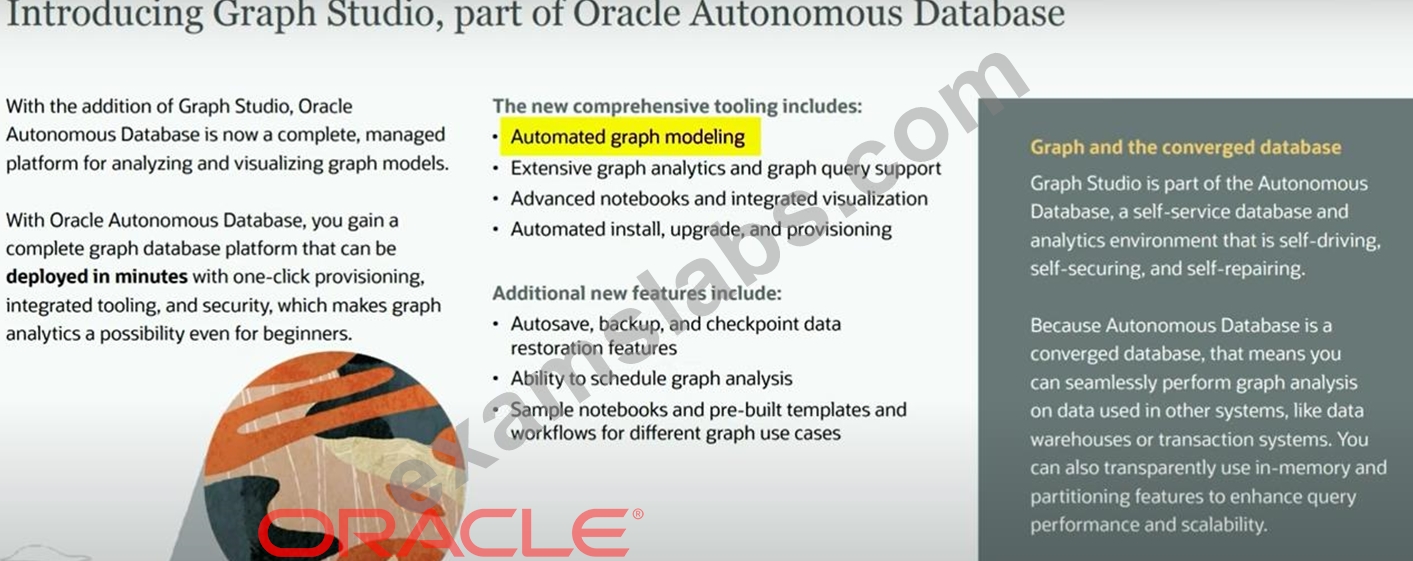
Which three are use cases for Graph Studio? (Choose three.)
- A. Churn analysis
- B. Facial recognition
- C. Pattern matching
- D. 3-D modelling
- E. Clustering
Answer: C,D,E
Explanation: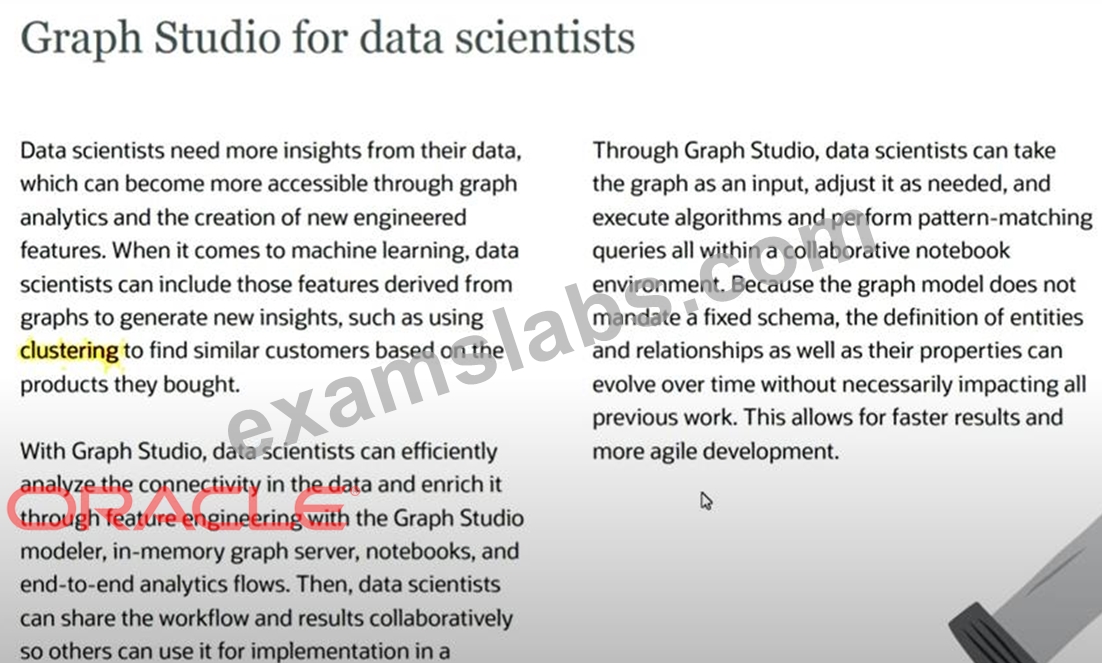
NEW QUESTION # 26
In Graph Studio which you can use to create a graph?
- A. NoSQL configuration
- B. Graph created by a special tool downloaded from Oracle.com
- C. Graph analytics algorithms
- D. Tables in an Autonomous Database instance
- E. A graph license key
Answer: D
NEW QUESTION # 27
Which statement is FALSE about Data Insights?
- A. Data Insights provides a wide range of graphical data presentation capabilities
- B. The results of the insight analysis appear as a series of bar charts in the Data Insights dashboard
- C. Data Insights displays information about patterns and anomalies in the data of entities in your Oracle Autonomous Database
- D. Data insights are automatically generated by various analytic functions built into the database
Answer: B
NEW QUESTION # 28
Which statement is not correct when the Autonomous Database is stopped?
- A. CPU billing is halted
- B. User with DWROLE can still access the database
- C. Tools are no longer able to connect to a stopped instance
- D. In-flight transactions queries are stopped
Answer: B
Explanation: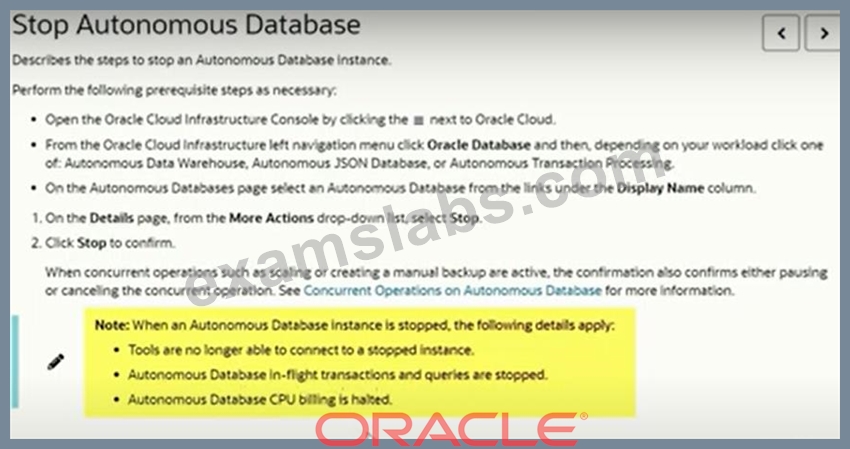
NEW QUESTION # 29
What are the two differentiators of Oracle Autonomous Data Base on Dedicated Infrastructure?
- A. Users are offered greater reutral and isolation starting at the Exade Cloud infrastructure level
- B. Users have OS access to the database machine
- C. Users can customize the OS stack and add additional packages
- D. Users have SYS privileges in the database
- E. Users have more control over the maintenance schedule
Answer: A,D
NEW QUESTION # 30
You are requested to analyze a year's stock purchase data which is stored in Autonomous Data Warehouse instance.
Which tool would you use to automate data exploration and create pivot tables?
- A. APEX
- B. Data Load
- C. SQL Developer Web
- D. Business Models
Answer: B
NEW QUESTION # 31
What are two differentiators of Oracle Autonomous Database Dedicated Infrastructure?
- A. Users have OS access to the database machine.
- B. Users can customize the OS stack and add additional packages
- C. Users can customize the maintenance schedule.
- D. Users have SYS privileges in the database.
- E. It offers greater control and isolation starting at the Exadata cloud infrastructure level.
Answer: C,E
Explanation:
https://docs.oracle.com/en/cloud/paas/autonomous-database/adbat/index.html#articletitle
NEW QUESTION # 32
What command should you issue to enable application continuity on Autonomous Database Shared Infrastructure?
- A. alter session set application_continuity=true
- B. alter database set application_continuity=true
- C. alter system set application_continuity=true
- D. exec dbms_cloucl_admin. enable_app_cont ( ' <service_name> ' ) ;
Answer: D
Explanation:
https://docs.oracle.com/en/cloud/paas/autonomous-database/adbsa/dbms-cloud-admin.html#GUID-42B9DDB0-12A7-4EE3-9860-30EFA41061E9 If it was asking for Autonomous Database Dedicated Infrastructure, then answer would be execute DBMS_APP_CONT_ADMIN.ENABLE_AC( 'databaseid_tpurgent.adb.oraclecloud.com', 'LEVEL1', 600);
NEW QUESTION # 33
Which two license types does the customer need to benefit from BYOL when leveraging on-premise Enterprise Database licenses in Oracle Autonomous Database?
- A. Active Data Guard
- B. Transparent Data Encryption
- C. RAC, but only when scaling beyond 16 OCPUs
- D. Multitenant
- E. Exadata
Answer: C,D
Explanation:
Refer to https://www.oracle.com/autonomous-database/autonomous-data-warehouse/pricing/ If you run Oracle Database Enterprise Edition and the required options listed below, then your BYOL requirements are as follows:
For 1-16 OCPUs of a single Oracle Autonomous Data Warehouse instance:
For each supported Processor license of Oracle Database Enterprise Edition plus Options: Multitenant, you may activate up to 2 OCPUs of the BYOL Cloud Service.
For every 25 supported Named User Plus licenses of Oracle Database Enterprise Edition plus Options: Multitenant, you may activate 1 OCPU of the BYOL Cloud Service.
For 17 OCPUs or more of a single Oracle Autonomous Data Warehouse:
For each supported Processor license of Oracle Database Enterprise Edition plus Options: Multitenant and Real Application Clusters, you may activate up to 2 OCPUs of the BYOL Cloud Service.
For every 25 supported Named User Plus licenses of Oracle Database Enterprise Edition plus Options: Multitenant and Real Application Clusters, you may activate 1 OCPU of the BYOL Cloud Service.
https://www.oracle.com/database/technologies/datawarehouse-bigdata/adb-faqs.html "Do customers need Exadata licenses to benefit from BYOL?"
NEW QUESTION # 34
Which statement is FALSE for Oracle Data Safe? (Choose the best answer.)
- A. Oracle Data Safe only supports Autonomous Databases
- B. Oracle Data Safe helps you find sensitive data in your database by inspecting the actual data in your database and its data dictionary
- C. Oracle Data Safe evaluates user types, how users are authenticated, and the password policies assigned to each user
- D. Oracle Data Safe helps you assess the security of your cloud database configurations by analyzing database configurations
Answer: A
NEW QUESTION # 35
How can an Autonomous Database resource be provisioned without logging into the Oracle Cloud Infrastructure console?
- A. Using Database Configuration Assistant (DBCA) on the database server.
- B. Using the Oracle Cloud Infrastructure Command Line interface tool or REST API calls.
- C. It cannot be done.
- D. Connecting to the Cloud Infrastructure Command console via SSH wallet.
Answer: B
Explanation:
The CLI is a small footprint tool that you can use on its own or with the Console to complete Oracle Cloud Infrastructure tasks. The CLI provides the same core functionality as the Console, plus additional commands.
https://blogs.oracle.com/datawarehousing/managing-autonomous-data-warehouse-using-oci-curl Examples of using Autonomous Database managing by REST API
https://oracle.github.io/learning-library/workshops/autonomous-transaction-processing/LabGuide900ConfigureOCI-CLI.md
NEW QUESTION # 36
Which two actions can you perform with Autonomous Data Guard enabled on Autonomous Database on Shared Infrastructure?
- A. Reinstate
- B. Switchover
- C. Change Protection Mode
- D. Failover
- E. View Apply Lag
Answer: B,D
Explanation:
Autonomous Data Guard is a feature of Autonomous Database on Shared Infrastructure that provides data protection and disaster recovery for your database by creating and maintaining a standby database that continuously gets updated with the changes from the primary database4. With Autonomous Data Guard enabled, you can perform a switchover or a failover operation to switch roles between the primary and standby databases. A switchover is a planned role reversal that does not affect availability5. A failover is an unplanned role reversal that occurs when the primary database becomes unavailable due to a failure or disaster6. You cannot perform a reinstate operation, which is used to re-synchronize a disabled standby database with the primary database after a failover7. You also cannot change the protection mode, which determines how redo data is transmitted from the primary database to the standby database4. You can only view the apply lag, which is the difference between the redo applied on the standby database and the redo generated on the primary database5. Reference:
Use Standby Databases with Autonomous Data Guard for Disaster Recovery - Oracle Help Center.
Switch Roles in an Autonomous Data Guard Configuration - Oracle Help Center.
Fail Over to the Standby in an Autonomous Data Guard Configuration - Oracle Help Center.
Reinstate the Disabled Standby in an Autonomous Data Guard Configuration - Oracle Help Center.
NEW QUESTION # 37
......
Oracle 1z0-931-23 Exam Syllabus Topics:
| Topic | Details |
|---|---|
| Topic 1 |
|
| Topic 2 |
|
| Topic 3 |
|
| Topic 4 |
|
| Topic 5 |
|
| Topic 6 |
|
| Topic 7 |
|
| Topic 8 |
|
Oracle Autonomous Database Cloud 2023 Specialist Practice Tests 2024 | Pass 1z0-931-23 with confidence!: https://drive.google.com/open?id=1AnQMK-L6lPTmYXtXC1iafaxp3PnpdDh4
Online Exam Practice Tests with detailed explanations!: https://www.examslabs.com/Oracle/Oracle-Cloud/best-1z0-931-23-exam-dumps.html