

Full NCP-AIO Practice Test and 68 unique questions with explanations waiting just for you!
NVIDIA-Certified Professional Dumps NCP-AIO Exam for Full Questions - Exam Study Guide
NVIDIA NCP-AIO Exam Syllabus Topics:
| Topic | Details |
|---|---|
| Topic 1 |
|
| Topic 2 |
|
| Topic 3 |
|
| Topic 4 |
|
NEW QUESTION # 27
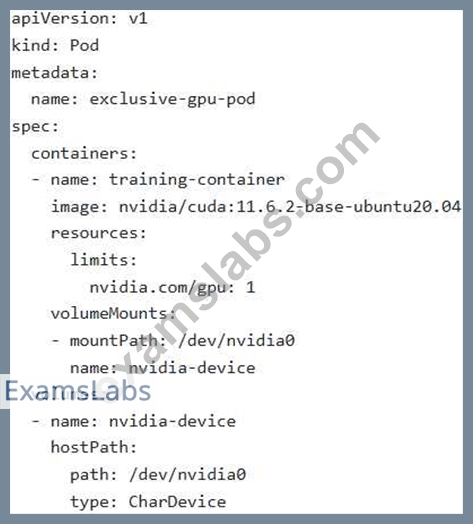
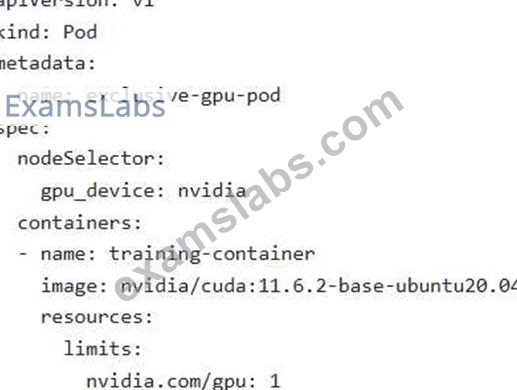
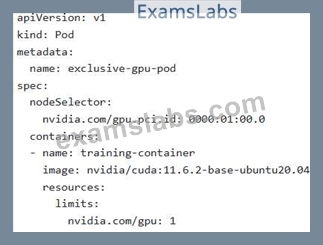
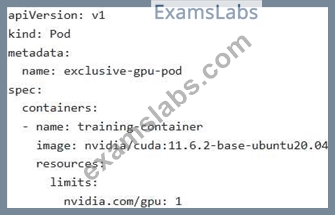
You are managing a Kubernetes cluster used for AI model training. One of the training jobs requires exclusive access to a specific GPU with PCI ID Which of the following Kubernetes manifests correctly configures this requirement for the pod?
- A.
- B.
- C.
- D.
- E.
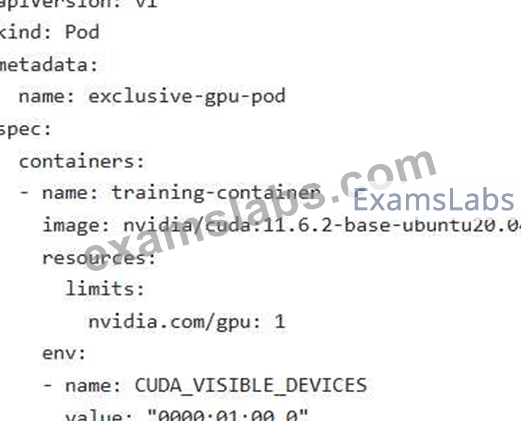
Answer: E
Explanation:
The correct answer is A. Setting the 'CUDA VISIBLE DEVICES environment variable with the specific PCI ID ensures the container only sees that GPU. Option B attempts to use a nodeselector, which is not the correct way to request specific GPUs; it's more for scheduling to a node with GPUs. Options C and D do not enforce PCI ID exclusivity. Option E is too generic and doesn't target a specific GPU.
NEW QUESTION # 28
You are deploying a cloud VMI container with Kubernetes. Your application requires a specific NVIDIA driver version. How do you ensure the correct driver version is used within the container, especially when the host node might have a different driver version?
- A. Specify the desired driver version in the Kubernetes Deployment manifest using the 'nvidia.com/gpu.driver.version' resource limit.
- B. The NVIDIA driver version used on the host node is automatically inherited by the container; no specific configuration is needed.
- C. Bake the required NVIDIA driver version directly into the container image during the Docker build process.
- D. Configure the Kubernetes node's operating system to always use the desired NVIDIA driver version globally.
- E. Utilize the NVIDIA Device Plugin for Kubernetes and configure it to inject the correct driver libraries into the container during runtime.
Answer: C,E
Explanation:
Using the NVIDIA Device Plugin allows for dynamic injection of driver libraries. Baking the driver into the container also works, but it results in a larger image and less flexibility. Option A is not a valid resource limit. Overriding the host OS driver is not practical for multi-tenant environments. Relying on host inheritance is risky as driver versions can vary.
NEW QUESTION # 29
You're trying to build a Docker image for a PyTorch application that requires CUDA 11.6. Your Dockerfile includes the following line: 'FROM nvidia/cuda:ll .6-base-ubuntu20.04'. However, during the build process, you encounter errors related to missing CUDA libraries.
What could be the problem and what are possible solutions?
- A. You are using the wrong base image. Use 'nvidia/cuda:ll .6-devel-ubuntu20.04' instead, as it includes development libraries.
- B. You are not setting the CUDA HOME environment variable inside the Dockerfile. Set 'ENV CUDA HOME=/usr/local/cuda'
- C. The host machine's NVIDIA driver version is incompatible with CUDA 11.6. Update the host driver to a compatible version.
- D. The 'nvidia/cuda:ll .6-base-ubuntu20.04' image only provides the base CUDA environment. You need to install additional CUDA libraries like 'libcudnn8' explicitly using 'apt-get' in your Dockerfile.
- E. The Docker daemon does not have enough resources to build the image. Increase the Docker daemon's memory and CPU limits.
Answer: A,D
Explanation:
The '-base image provides a minimal CUDA environment, often lacking necessary libraries. The '-dever image includes development libraries, and explicit installation of specific libraries (like cuDNN) might be required. CUDA_HOME might also be necessary to explicitly set, but the more likely issues are the missing libraries and the image selection.
NEW QUESTION # 30
You're deploying a multi-GPU VMI container using PyTorch's 'torch.distributed' library for distributed training. You're using 'torch.distributed.launch' to start the training processes. However, you encounter the following error: 'RuntimeError: Address already in use'. What's the MOST likely cause and how can you resolve it?
- A. The error means the container doesn't have enough memory. Increase the container's memory limit.
- B. This error is not related to VMI containers at all.
- C. The error is due to multiple processes trying to bind to the same port for inter-process communication. Specify a unique port using the '-master_port' argument in 'torch.distributed.launcm or setting the 'MASTER PORT environment variable.
- D. The error indicates a conflict with the NVIDIA driver. Update to the latest driver version.
- E. The error is related to an incorrect CUDA version. Ensure the CUDA version inside the container matches the host system.
Answer: C
Explanation:
The 'Address already in use' error in 'torch.distributed' typically arises when multiple processes attempt to bind to the same port for communication. Specifying a unique port for each distributed training job using '-master_port' or the 'MASTER PORT environment variable resolves this conflict. This prevents processes from interfering with each other.
NEW QUESTION # 31
Which of the following statements regarding the NVIDIA Device Plugin for Kubernetes are correct?
- A. It automatically installs the NVIDIA drivers on the nodes.
- B. It replaces the need for the NVIDIA Container Toolkit.
- C. It ensures that containers have the necessary NVIDIA libraries and tools.
- D. It allows Kubernetes to be aware of the NVIDIA GPUs present on the nodes.
- E. It exposes GPUs as schedulable resources to Kubernetes.
Answer: D,E
Explanation:
The correct answers are A and C. The NVIDIA Device Plugin discovers NVIDIA GPUs on each node and advertises them as resources to the Kubernetes scheduler. It enables Kubernetes to allocate GPUs to containers. It does not install drivers (that's a separate process). It works with the NVIDIA Container Toolkit to provide the necessary libraries within the container. It does not replace the NVIDIA Container Toolkit; they work in conjunction.
NEW QUESTION # 32
A system administrator is troubleshooting a Docker container that is repeatedly failing to start. They want to gather more detailed information about the issue by generating debugging logs.
Why would generating debugging logs be an important step in resolving this issue?
- A. Debugging logs disable other logging mechanisms, reducing noise in the output.
- B. Debugging logs prevent the container from being removed after it stops, allowing for easier inspection.
- C. Debugging logs fix issues related to container performance and resource allocation.
- D. Debugging logs provide detailed insights into the Docker daemon's internal operations.
Answer: D
Explanation:
Comprehensive and Detailed Explanation From Exact Extract:
Generatingdebugging logsenables detailed visibility into the internal operations of the Docker daemon. These logs expose low-level errors, misconfigurations, and runtime issues that standard logs might not capture, making them essential for diagnosing why a container repeatedly fails to start.
NEW QUESTION # 33
You need to upgrade the Run.ai platform on your on-premise Kubernetes cluster. What is the RECOMMENDED procedure for performing this upgrade to minimize downtime and ensure a smooth transition?
- A. Follow the official Run.ai documentation for the specific upgrade path, typically involving a rolling update procedure using Helm or kubectl apply.
- B. Upgrade the Kubernetes cluster itself before upgrading Run.ai.
- C. Delete the existing Run.ai deployment and install the new version from scratch.
- D. Simply restart all Run.ai pods in the cluster.
- E. Edit the Run.ai deployment YAML file directly and apply the changes.
Answer: A
Explanation:
Following the official Run.ai documentation is crucial for a smooth upgrade. Run.ai typically provides detailed instructions for upgrading the platform, often involving a rolling update procedure using Helm or kubectl apply. This minimizes downtime by updating components incrementally. Deleting and reinstalling is disruptive and risky. Directly editing the deployment YAML is not recommended. While Kubernetes version compatibility is important, Run.ai upgrades should generally be performed independently, following Run.ai's documented procedure. Restarting pods is insufficient for a platform upgrade.
NEW QUESTION # 34
You are using Fleet Command to manage AI model deployments to a diverse fleet of edge devices with varying hardware capabilities.
Some devices are equipped with GPUs, while others rely on CPUs for inference. How can you ensure that the correct version of the AI model is deployed to each device type?
- A. Manually select the appropriate model version for each device during deployment.
- B. Develop a custom script to determine device capabilities and deploy models accordingly.
- C. Use Fleet Command's device targeting feature with appropriate labels to define deployment rules based on hardware capabilities.
- D. Deploy the same model version to all devices and rely on the devices to automatically adapt to their hardware.
- E. Create separate Fleet Command organizations for each device type.
Answer: C
Explanation:
Device targeting with labels is the most efficient and scalable way to manage deployments to diverse hardware. Separate organizations (A) are overly complex. Manual selection (C) is error-prone. Relying on automatic adaptation (D) might not be reliable. Custom scripts (E) add unnecessary complexity when Fleet Command provides built-in features.
NEW QUESTION # 35
You are designing a data center that must support both interactive AI development and large-scale batch training jobs. You want to maximize GPU utilization while ensuring that interactive users have a responsive experience. Which of the following strategies is MOST effective?
- A. Use NVIDIA MPS (Multi-Process Service) to allow interactive users and batch jobs to share GPUs concurrently, and implement QOS to prioritize interactive workloads.
- B. Schedule batch jobs to run only during off-peak hours when interactive users are not active.
- C. Oversubscribe all GPUs to maximize utilization, even if it degrades interactive performance.
- D. Run all workloads on a single large GPU server to simplify management.
- E. Allocate dedicated GPUs to interactive users and run batch jobs on idle CPUs.
Answer: A
Explanation:
NVIDIA MPS allows multiple processes to share a GPU concurrently, which maximizes utilization. QOS ensures that interactive workloads receive priority, maintaining a responsive experience. Dedicated GPUs for interactive users wastes resources when they are idle. Scheduling batch jobs for off-peak hours is limiting and inefficient. Oversubscribing without QOS can severely impact interactive performance. Running all workloads on a single server creates a single point of failure and limits scalability.
NEW QUESTION # 36
You are designing storage for an AI model that performs real-time object detection on streaming video. Which of the following storage characteristics are most important?
- A. High sustained write throughput for incoming video streams.
- B. Support for cold storage.
- C. Low latency for accessing video frames during inference.
- D. Large capacity for long-term video archival.
- E. Data deduplication for minimizing storage costs.
Answer: A,C
Explanation:
Real-time object detection requires both the ability to ingest incoming video streams quickly (high write throughput) and access frames with minimal delay (low latency) for inference. Long-term archival and deduplication are less critical for real-time performance. Cold storage is not relevant in the operational data flow.
NEW QUESTION # 37
Which network topology is generally preferred for AI training workloads in a data center, emphasizing low latency and high bandwidth between GPU servers?
- A. Token Ring.
- B. A single IOGbE switch connecting all nodes.
- C. Spanning Tree Protocol (STP) based Ethernet.
- D. Clos network (e.g., Fat-Tree) with RoCEv2 or InfiniBand.
- E. Ethernet with link aggregation (LAG) only.
Answer: D
Explanation:
Clos networks, particularly Fat-Tree topologies utilizing RoCEv2 or InfiniBand, provide the necessary low latency and high bandwidth for efficient inter-GPU communication during distributed training. STP based Ethernet is unsuitable due to its blocking nature and potential for high latency. LAG helps but doesn't provide the full benefits of a Clos network.
NEW QUESTION # 38
A user reports that their AI training job running on a BCM-managed cluster is experiencing slow 1/0 performance. What steps would you take to diagnose and resolve the issue, considering the potential involvement of storage?
- A. Monitor the storage system's performance metrics (IOPS, latency, throughput) using the storage vendor's monitoring tools.
- B. Verify that the correct storage class is being used for the persistent volumes used by the training job.
- C. Increase the pod's CPU and memory limits to improve 1/0 performance.
- D. Inspect the pod's logs for any I/O related errors or warnings.
- E. Check the network bandwidth between the compute nodes and the storage system using *iperf or similar tools.
Answer: A,B,D,E
Explanation:
Network bandwidth can be a bottleneck. Storage system metrics are crucial for identifying storage-related issues. The storage class determines the underlying storage type and performance characteristics. Pod logs might contain error messages. Increasing CPU/memory won't directly solve I/O performance issues if the bottleneck is elsewhere.
NEW QUESTION # 39
A system administrator needs to configure and manage multiple installations of NVIDIA hardware ranging from single DGX BasePOD to SuperPOD.
Which software stack should be used?
- A. Base Command Manager
- B. Magnum IO
- C. Fleet Command
- D. NetQ
Answer: A
Explanation:
Comprehensive and Detailed Explanation From Exact Extract:
NVIDIA's Base Command Manager is the software stack designed specifically for configuration, management, and monitoring of NVIDIA DGX systems, from a single DGX BasePOD up to large-scale SuperPOD deployments. It provides centralized management capabilities to orchestrate AI infrastructure, simplifying deployment, hardware monitoring, and lifecycle management across multiple clusters and data centers.
* NetQ is focused on network monitoring and diagnostics rather than overall hardware cluster management.
* Fleet Command is an enterprise SaaS solution to deploy and manage AI infrastructure in hybrid cloud environments but is not specifically targeted at on-premises DGX BasePOD to SuperPOD scale hardware management.
* Magnum IO is NVIDIA's high-performance data and storage software stack for managing I/O but not hardware or cluster configuration management.
Therefore, Base Command Manager is the correct and dedicated tool for managing multiple installations of NVIDIA DGX hardware spanning from BasePOD to SuperPOD environments.
This is consistent with NVIDIA's official AI Operations documentation and product descriptions highlighting Base Command Manager as the unified command and control platform for AI infrastructure management.
NEW QUESTION # 40
You are deploying a DOCA application on a BlueField-3 DPU. Which of the following components are essential for enabling RDMA communication between the DPU and the host server?
- A. Mellanox OFED (MLNX_OFED) driver on both the DPU and the host.
- B. Kernel bypass techniques like DPDK only on the DPU.
- C. Appropriate firewall rules configured on both the host and the DPU.
- D. Correctly configured PCl passthrough or SR-IOV on the host for the DPU's RDMA interfaces.
- E. DOCA SDK installed on the DPU only.
Answer: A,D
Explanation:
RDMA communication requires the correct drivers (MLNX_OFED) on both ends and proper PCI passthrough or SR-IOV configuration on the host to expose the DPU's RDMA capabilities. DOCA SDK helps build the applications, firewall rules are orthogonal and DPDK is one of the option. Kernel bypass on both host and dpu is needed.
NEW QUESTION # 41
You are running a distributed TensorFlow training job on your Kubernetes cluster. The job consists of a parameter server and multiple worker pods. To maximize GPU utilization and ensure efficient communication, you want to place the parameter server and workers on nodes that are as close as possible within the network topology. Which Kubernetes feature can assist you in achieving this?
- A. Resource Quotas.
- B. Pod anti-affinity.
- C. Pod Priority.
- D. Topology Spread Constraints.
- E. NodeSelector.
Answer: D
Explanation:
The correct answer is C. Topology Spread Constraints allow you to control how pods are spread across your cluster based on topology domains like nodes, racks, or zones. By specifying the relevant topology domain (e.g., for nodes), you can encourage the scheduler to place related pods (parameter server and workers) on the same or nearby nodes. Pod anti-affinity (A) would work to keep pods separated. NodeSelector (B) can place pods on specific nodes, but doesn't inherently understand network topology. Resource Quotas (D) and Pod Priority (E) don't directly address pod placement based on network proximity.
NEW QUESTION # 42
A system administrator is looking to set up virtual machines in an HGX environment with NVIDIA Fabric Manager.
What three (3) tasks will Fabric Manager accomplish? (Choose three.)
- A. Configures routing among NVSwitch ports.
- B. Coordinates with the GPU driver to initialize and train NVSwitch to GPU NVLink interconnects.
- C. Installs vGPU driver as part of the Fabric Manager Package.
- D. Installs GPU operator
- E. Coordinates with the NVSwitch driver to train NVSwitch to NVSwitch NVLink interconnects.
Answer: A,B,E
Explanation:
Comprehensive and Detailed Explanation From Exact Extract:
NVIDIA Fabric Manager is responsible for managing the fabric interconnect in HGX systems, including:
* Configuring routing among NVSwitch ports (A)to optimize communication paths.
* Coordinating with the NVSwitch driver to train NVSwitch-to-NVSwitch NVLink interconnects (C)for high-speed link setup.
* Coordinating with the GPU driver to initialize and train NVSwitch-to-GPU NVLink interconnects (D) ensuring optimal connectivity between GPUs and switches.
Installing the GPU operator and vGPU driver is typically handled separately and not part of Fabric Manager's core tasks.
NEW QUESTION # 43
You are managing a high availability (HA) cluster that hosts mission-critical applications. One of the nodes in the cluster has failed, but the application remains available to users.
What mechanism is responsible for ensuring that the workload continues to run without interruption?
- A. Data replication between nodes to ensure data integrity.
- B. Load balancing across all nodes in the cluster.
- C. Manual intervention by the system administrator to restart services.
- D. The failover mechanism that automatically transfers workloads to a standby node.
Answer: D
Explanation:
Comprehensive and Detailed Explanation From Exact Extract:
In an HA cluster, thefailover mechanismis responsible for detecting node failures and automatically transferring workloads to a standby or redundant node to maintain service availability. This process ensures mission-critical applications continue running without interruption. Load balancing helps distribute traffic but does not handle node failures. Manual intervention is not ideal for HA, and data replication ensures data integrity but does not itself manage workload continuity.
NEW QUESTION # 44
Consider a scenario where you're trying to run a Docker container that uses the NVIDIA MPS (Multi-Process Service). However, you keep encountering errors indicating that MPS is not properly initialized within the container. What steps should you take to troubleshoot this issue?
- A. Confirm that the CUDA version within the container is compatible with the NVIDIA drivers on the host and supports MPS.
- B. Verify that MPS is enabled on the host system before launching the Docker container. This typically involves running 'nvidia-smi -i O -gom 1 ' and 'nvidia-cuda- mps-control -d'.
- C. Make sure that the Docker container has the necessary permissions to access the NVIDIA devices. This may involve setting the correct user and group IDs.
- D. Ensure that the NVIDIA drivers on the host system are compatible with MPS. MPS requires specific driver versions.
- E. Check if any other processes on the host system are already using the GPU exclusively, preventing MPS from initializing correctly.
Answer: A,B,C,D,E
Explanation:
All the options play a crucial role in ensuring that MPS functions correctly within a Docker container. MPS requires specific drivers and enabled on the host. Docker container permission should be set to access the NVIDIA devices. Other processes can hinder initialization, and CUDA version compatibility is essential.
NEW QUESTION # 45
What is the primary purpose of using a container runtime interface (CRI) with BCM and Kubernetes in an AI environment?
- A. To provide a standard interface for Kubernetes to interact with different container runtimes (e.g., Docker, containerd).
- B. To encrypt container images at rest and in transit.
- C. To handle networking for containers within the Kubernetes cluster.
- D. To schedule pods onto nodes based on resource availability.
- E. To manage the lifecycle of containers (create, start, stop, delete).
Answer: A
Explanation:
The CRI allows Kubernetes to work with various container runtimes without being tightly coupled to a specific implementation. It defines an interface that container runtimes must implement. While A is true for a container runtime, the CRI is about Kubernetes interacting with it. The others are related to other parts of Kubernetes.
NEW QUESTION # 46
You are deploying a containerized AI application from NGC on a cluster with multiple GPU nodes. You want to ensure that the application is distributed across multiple GPUs and nodes for maximum performance. What strategies can you employ to achieve this?
- A. Configure Kubernetes resource quotas to limit the number of GPUs available to each container.
- B. Use a single container with multi-GPU support and configure it to utilize all available GPUs on the cluster.
- C. Employ a message queue system like RabbitMQ or Kafka to distribute data to the containers running on different nodes.
- D. Utilize a distributed training framework like Horovod or DeepSpeed to distribute the workload across multiple GPUs and nodes.
- E. Deploy multiple replicas of the container, each configured to use a specific subset of GPUs on different nodes.
Answer: C,D,E
Explanation:
B, C, and E are correct. Deploying multiple container replicas allows for distribution across nodes. Distributed training frameworks manage workload distribution. A message queue facilitates data distribution to different nodes. A is incorrect as it relies on a single container handling all GPUs. D is used for resource management, not distribution.
NEW QUESTION # 47
You are using an all-flash array (AFA) for your AI training dat
a. You observe that the storage utilization is very low, but you are still experiencing performance bottlenecks. What could be the potential reasons for this and how can you troubleshoot them?
- A. The AFA is not configured correctly to handle the specific I/O patterns of your AI workload (e.g., random reads, large sequential writes). Check the AFA's configuration settings for block size, caching policies, and prefetching.
- B. The AFA's warranty has expired. Renewing the warranty will magically fix the performance issues.
- C. The AFA is over-provisioned, and the internal garbage collection processes are interfering with I/O operations. Reduce the amount of provisioned space.
- D. The network connection between the compute nodes and the AFA is the bottleneck. IJpgrade the network infrastructure or optimize the data transfer protocols.
- E. The AFA's internal controllers are overloaded, even though the overall storage utilization is low. Monitor the controller utilization and consider upgrading the AFA or distributing the workload across multiple AFAs.
Answer: A,D,E
Explanation:
IncorrectAFA configuration can lead to performance issues even with low utilization. Network bottlenecks can limit data transfer rates. Overloaded controllers within the AFA can become a bottleneck.
NEW QUESTION # 48
......
Authentic Best resources for NCP-AIO Online Practice Exam: https://www.examslabs.com/NVIDIA/NVIDIA-Certified-Professional/best-NCP-AIO-exam-dumps.html
Get the superior quality NCP-AIO Dumps Questions from ExamsLabs: https://drive.google.com/open?id=1nLZHWc88R36-ydFWFaQdBpILXcd94Ol5