

Real Exam Questions AZ-700 Dumps Exam Questions in here [May-2026]
Get Latest May-2026 Conduct effective penetration tests using AZ-700
Microsoft AZ-700 (Designing and Implementing Microsoft Azure Networking Solutions) Certification Exam is a professional-level certification that is designed to validate the skills and knowledge of IT professionals who specialize in designing and implementing complex networking solutions using Microsoft Azure. Designing and Implementing Microsoft Azure Networking Solutions certification exam tests a candidate's ability to design and implement secure and scalable network architectures on Azure, configure and maintain network infrastructure, and troubleshoot issues related to Azure networking.
The Microsoft AZ-700 exam is intended for individuals who have experience working with Azure technologies and have a good understanding of networking concepts. It is a rigorous exam that covers a wide range of topics, and it requires candidates to have hands-on experience with Azure networking solutions. AZ-700 exam is also designed to test the candidate's ability to design and implement networking solutions that are scalable and secure.
NEW QUESTION # 137
You have an Azure subscription.
You have the on-premises sites shown the following table.
You plan to deploy Azure Virtual WAN.
You are evaluating Virtual WAN Basic and Virtual WAN Standard.
Which type of Virtual WAN can you use for each site? To answer, select the appropriate options in the answer area.
NOTE: Each correct selection is worth one point.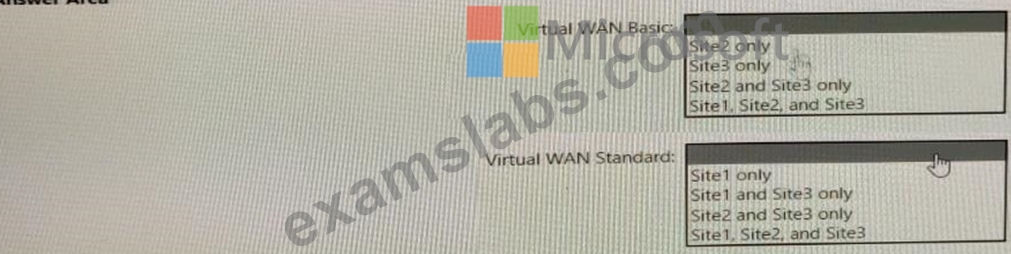
Answer:
Explanation: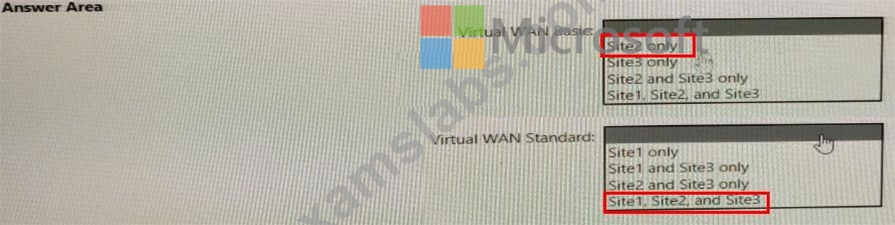
Reference:
https://docs.microsoft.com/en-us/azure/virtual-wan/virtual-wan-about
NEW QUESTION # 138
You have two Azure virtual networks named Vnet1 and Vnet2 in an Azure region that has three availability zones.
You deploy 12 virtual machines to each virtual network, deploying four virtual machines per zone. The virtual machines in Vnet1 host an app named App1. The virtual machines in Vnet2 host an app named App2.
You plan to use Azure Virtual Network NAT to implement outbound connectivity for App1 and App2.
You need to identify the minimum number of subnets and Virtual Network NAT instances required to meet the following requirements:
* A failure of two zones must NOT affect the availability of either App1 or App2.
* A failure of two zones must NOT affect the outbound connectivity of either App1 or App2.
What should you identify? To answer, select the appropriate options in the answer area.
NOTE: Each correct selection is worth one point.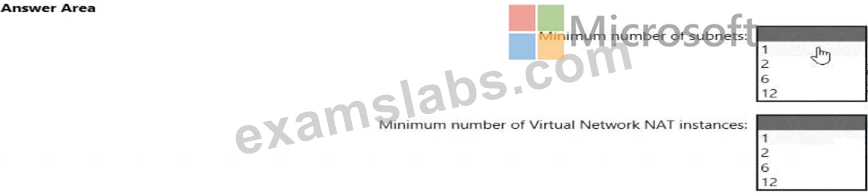
Answer:
Explanation: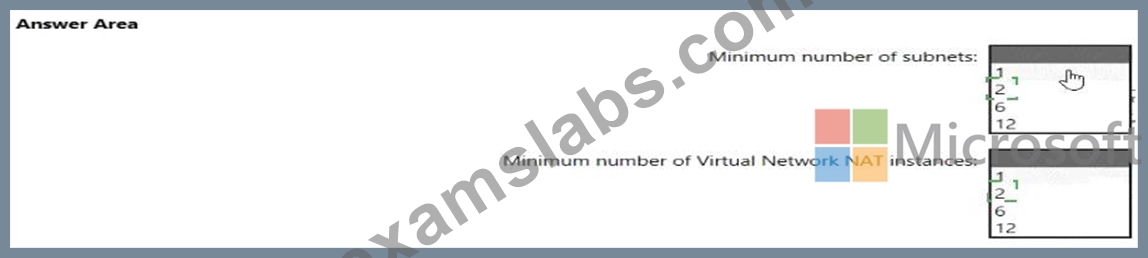
Explanation
Graphical user interface, table Description automatically generated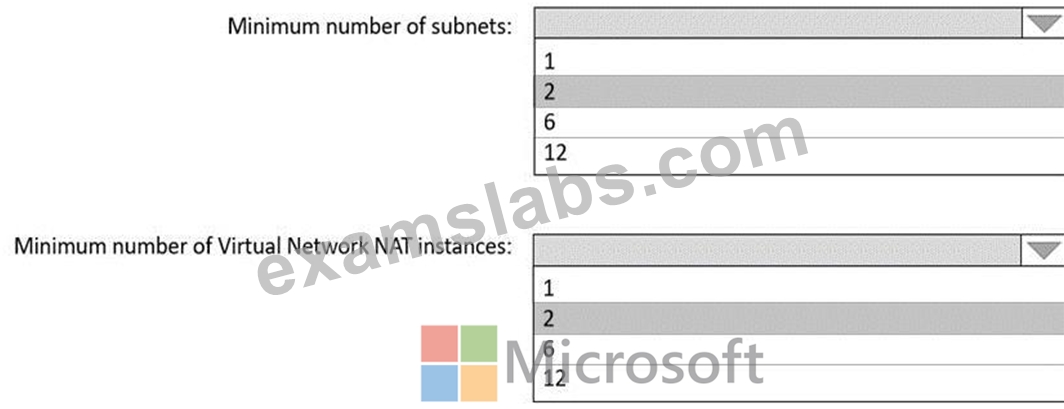
Reference:
https://docs.microsoft.com/en-us/azure/virtual-network/nat-gateway/nat-overview
NEW QUESTION # 139
You have three on-premises sites. Each site has a third-party VPN device.
You have an Azure virtual WAN named VWAN1 that has a hub named Hub1. Hub1 connects two of the three on-premises sites by using a Site-to-Site VPN connection.
You need to connect the third site to the other two sites by using Hub1.
Which four actions should you perform in sequence? To answer, move the appropriate actions from the list of actions to the answer area and arrange them in the correct order.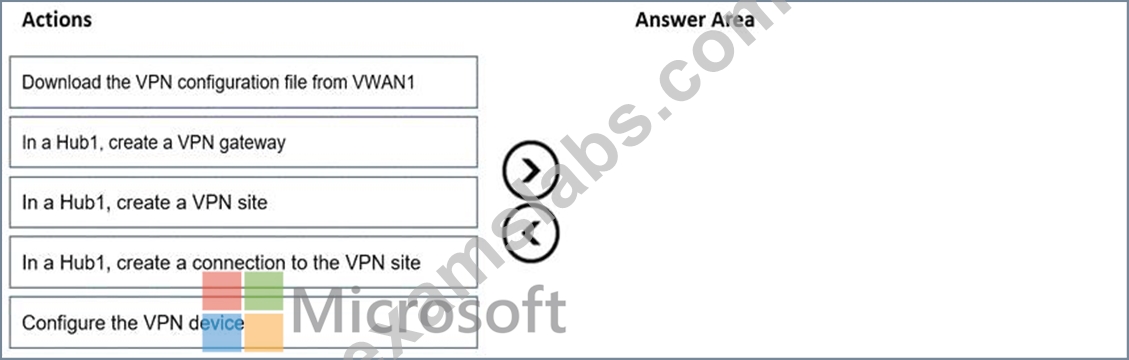
Answer:
Explanation: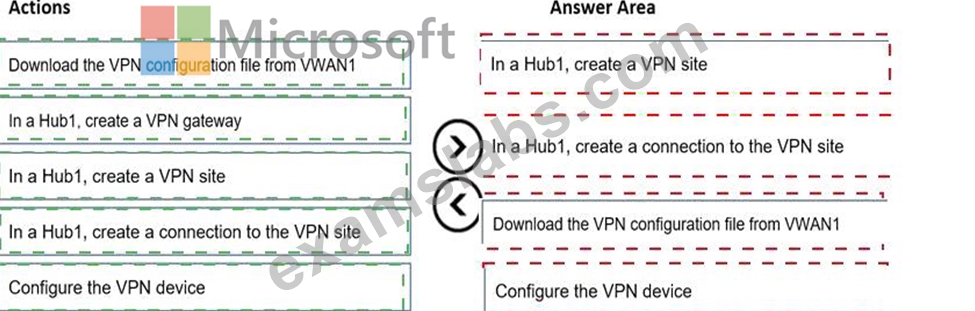
Explanation: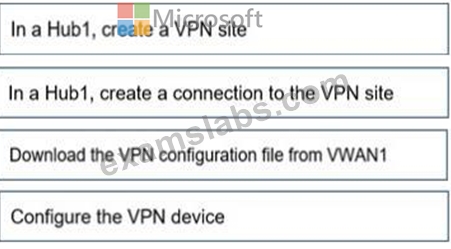
Reference:
https://docs.microsoft.com/en-us/azure/virtual-wan/virtual-wan-site-to-site-portal
NEW QUESTION # 140
You have art Azure subscription.
You plan to deploy Azure Front Door with Azure Web Application Firewall (WAF).
You plan to implement custom rules and managed rules that meet the following requirements:
* Block malicious bots.
* Throttle client IP addresses that exceed 100 connections per minute.
You need to identify which Front Door SKU to configure, and which type of rule to configure for each requirement. The solution must minimize administrative effort and costs.
What should identify? To answer, drag the appropriate options to the correct targets. Each option may be used once, more than once, or not at all. You may need to drag the split bar between panes or scroll to view content.
NOTE: Each correct selection is worth one point.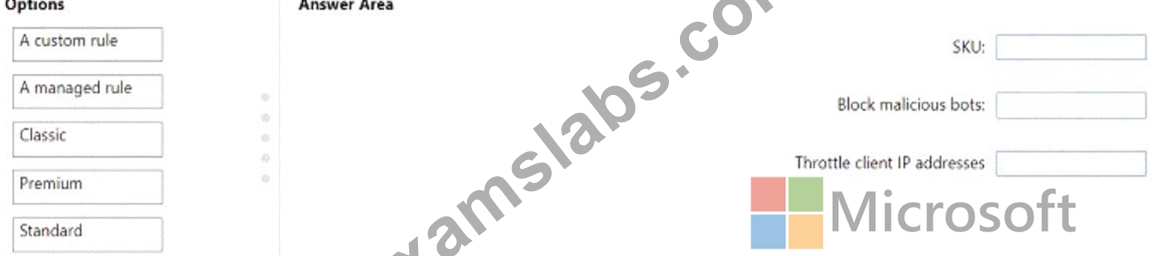
Answer:
Explanation: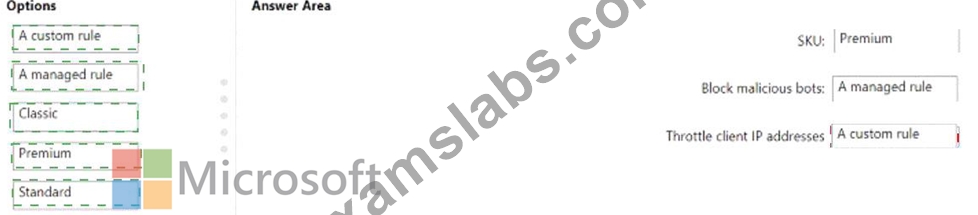
Explanation: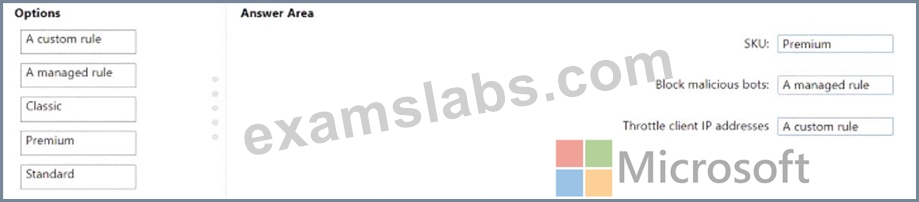
NEW QUESTION # 141
Your company has an Azure virtual network named Vnet1 that uses an IP address space of 192.168.0.0/20.
Vnet1 contains a subnet named Subnet1 that uses an IP address space of 192.168.0.0/24.
You create an IPv6 address range to Vnet1 by using a CIDR suffix of /48.
You need to enable the virtual machines on Subnet1 to communicate with each other by using IPv6 addresses assigned by the company. The solution must minimize the number of additional IPv4 addresses.
What should you do? To answer, select the appropriate options in the answer area.
NOTE: Each correct selection is worth one point.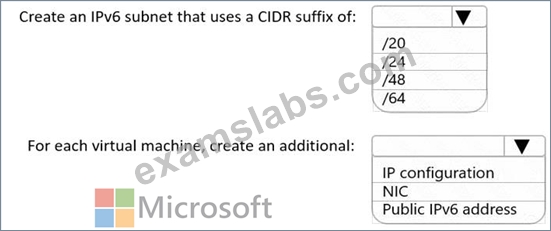
Answer:
Explanation: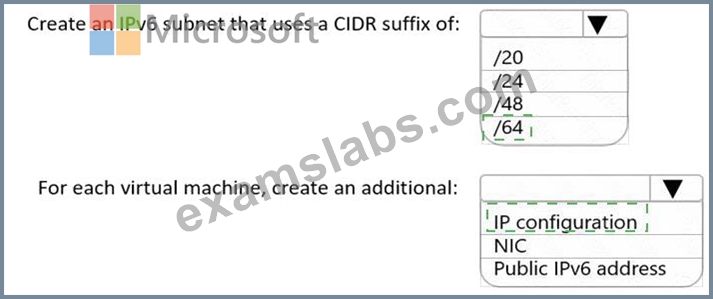
Explanation
Graphical user interface, text, application Description automatically generated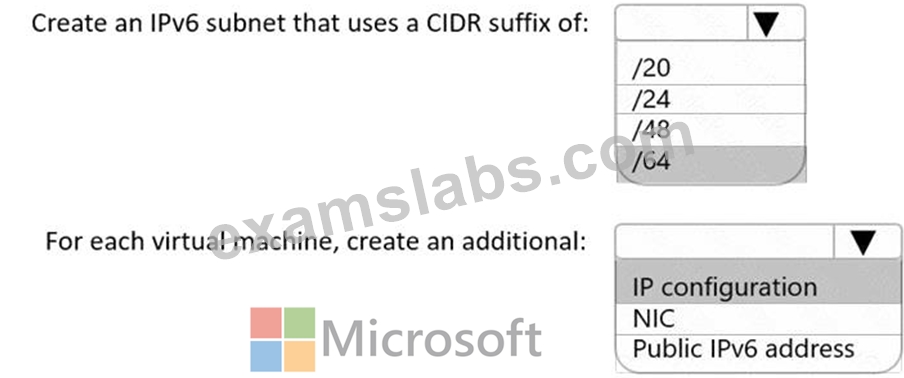
Reference:
https://docs.microsoft.com/en-us/azure/virtual-network/ipv6-overview
https://docs.microsoft.com/en-us/azure/virtual-network/ipv6-add-to-existing-vnet-powershell
1) Correct: /64
Explanation: The subnets for IPv6 must be exactly /64 in size. This ensures future compatibility should you decide to enable routing of the subnet to an on-premises network since some routers can only accept /64 IPv6 routes.
Source: https://docs.microsoft.com/en-us/azure/virtual-network/ip-services/ipv6-overview
2) Correct: Public IPv6 Address
Explanation: Add IPv6 configuration to NIC. "Configure all of the VM NICs with an IPv6 address using Add-AzNetworkInterfaceIpConfig" Source: https://docs.microsoft.com/en-us/azure/load-balancer/ipv6-add-to-existing-vnet-powershell
NEW QUESTION # 142
You have an Azure subscription that contains two virtual networks named Vnet1 and Vnet2.
You register a public DNS zone named fabrikam.com. The zone is configured as shown in the Public DNS Zone exhibit.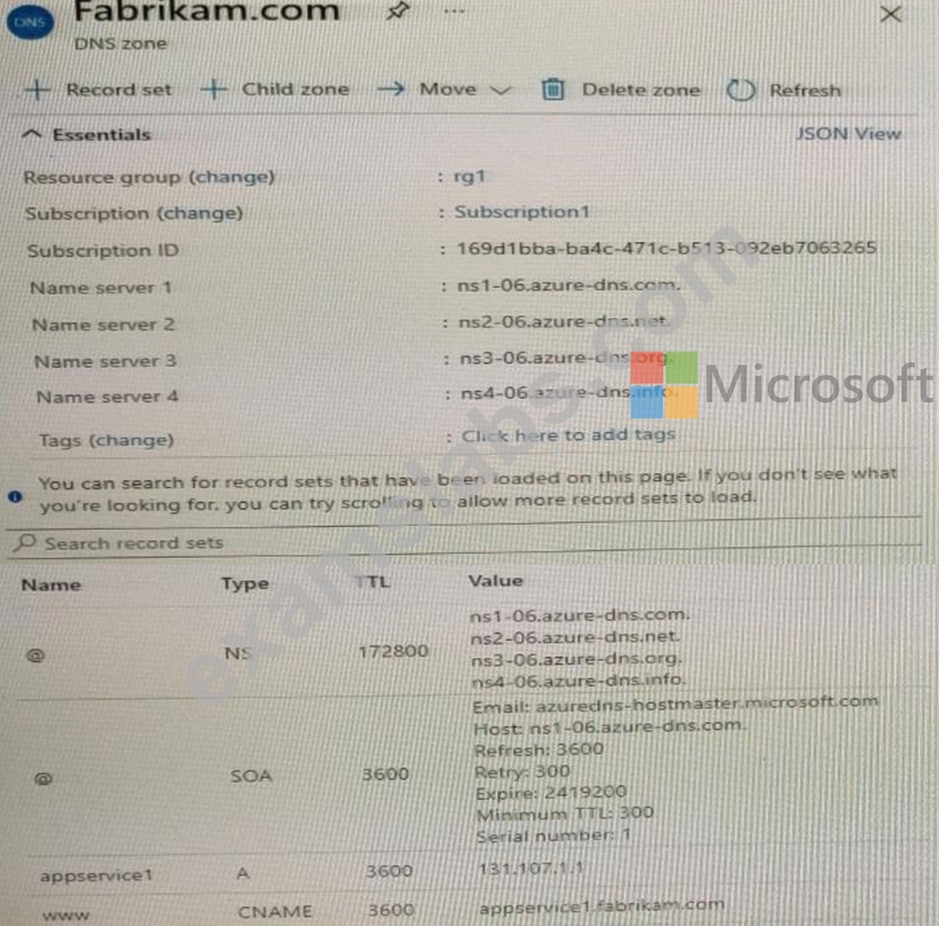
You have a private DNS zone named fabrikam.com. The zone is configured as shown in the Private DNS Zone exhibit.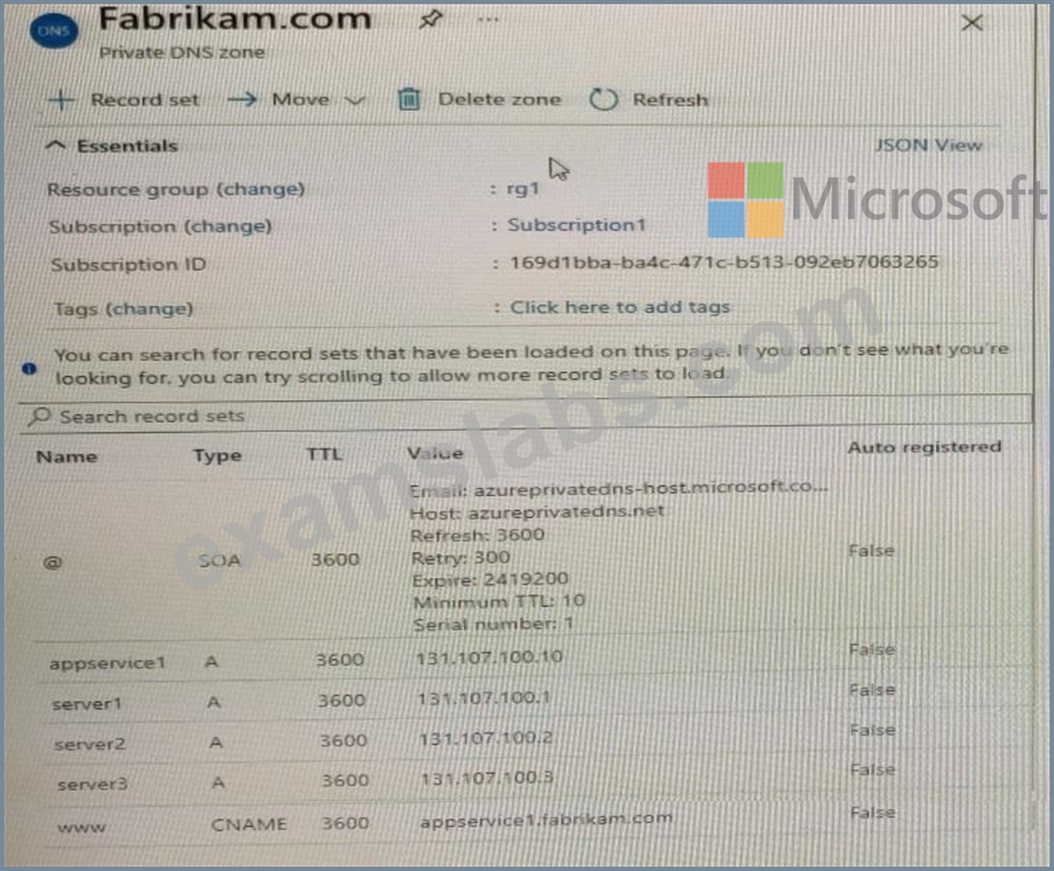
You have a virtual network link configured as shown in the Virtual Network Link exhibit.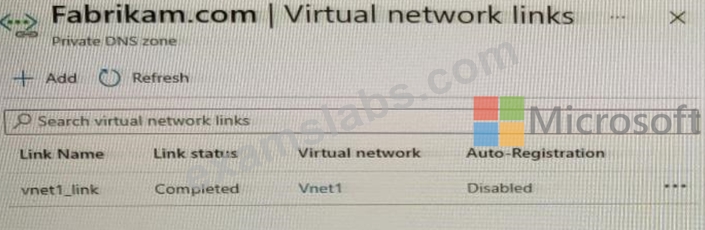
For each of the following statements, select Yes if the statement is true. Otherwise, select No.
NOTE: Each correct selection is worth one point.
Answer:
Explanation:
NEW QUESTION # 143
Your company has 10 instances of a web service. Each instance is hosted in a different Azure region and is accessible through a public endpoint.
The development department at the company is creating an application named App1. Every 10 minutes. App1 will use a list of end points and connect to the first available endpoint.
You plan to use Azure Traffic Manager to maintain the list of endpoints.
You need to configure a Traffic Manager profile that will minimize the impact of DNS caching.
What should you configure? To answer, select the appropriate options in the answer area.
NOTE: Each correct selection is worth one point.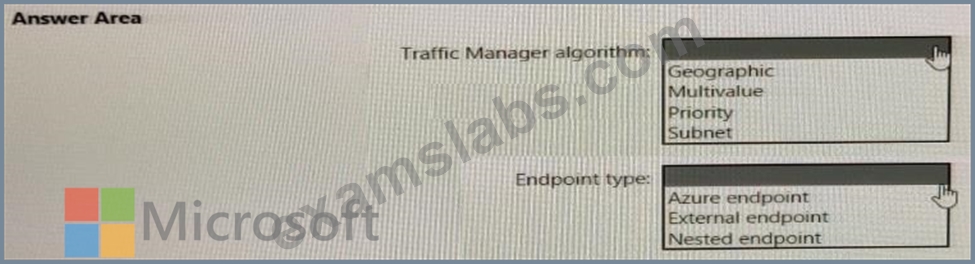
Answer:
Explanation: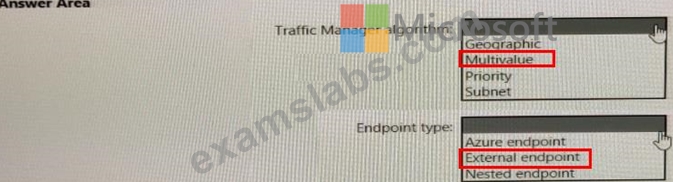
Reference:
https://docs.microsoft.com/en-us/azure/traffic-manager/traffic-manager-routing-methods
https://docs.microsoft.com/en-us/azure/traffic-manager/traffic-manager-endpoint-types
NEW QUESTION # 144
Note: This question is part of a series of questions that present the same scenario. Each question in the series contains a unique solution that might meet the stated goals. Some question sets might have more than one correct solution, while others might not have a correct solution.
After you answer a question in this section, you will NOT be able to return to it. As a result, these questions will not appear in the review screen.
You have an Azure application gateway that has Azure Web Application Firewall (WAF) enabled.
You configure the application gateway to direct traffic to the URL of the application gateway.
You attempt to access the URL and receive an HTTP 403 error. You view the diagnostics log and discover the following error.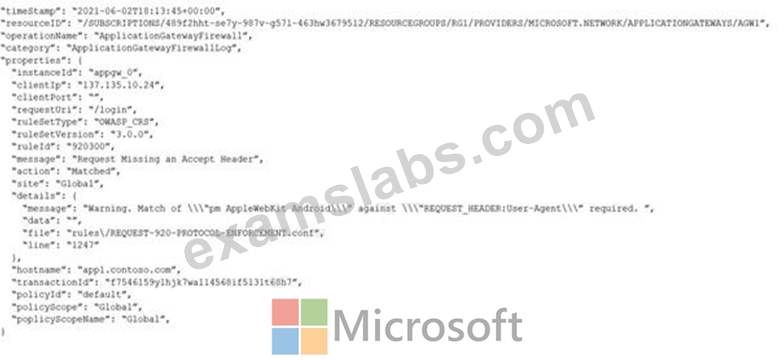
You need to ensure that the URL is accessible through the application gateway.
Solution: You add a rewrite rule for the host header.
Does this meet the goal?
- A. Yes
- B. No
Answer: B
Explanation:
https://docs.microsoft.com/en-us/azure/application-gateway/rewrite-http-headers-url#limitations
NEW QUESTION # 145
You have an on-premises datacenter.
You have an Azure subscription that contains 10 virtual machines and a virtual network named VNe1l in the East US Azure region. The virtual machines are connected to VNet1 and replicate across three availability zones.
You need to connect the datacenter to VNetl1by using ExpressRoute. The solution must meet the following requirements:
* Maintain connectivity to the virtual machines if two availability zones fail.
* Support 1000-Mbps connections-
What should you include in the solution? To answer, select the appropriate options in the answer area. NOTE:
Each correct selection is worth one point.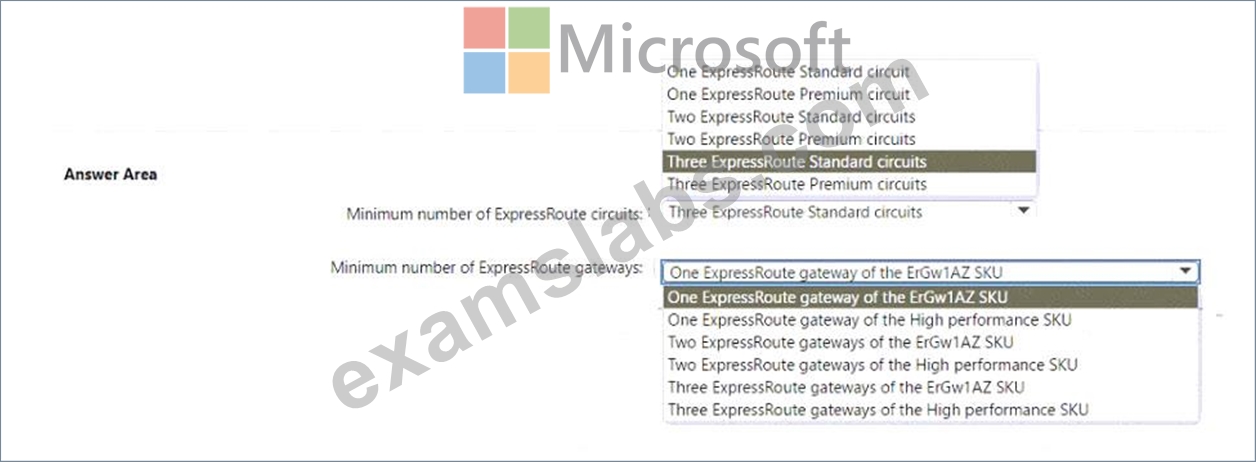
Answer:
Explanation: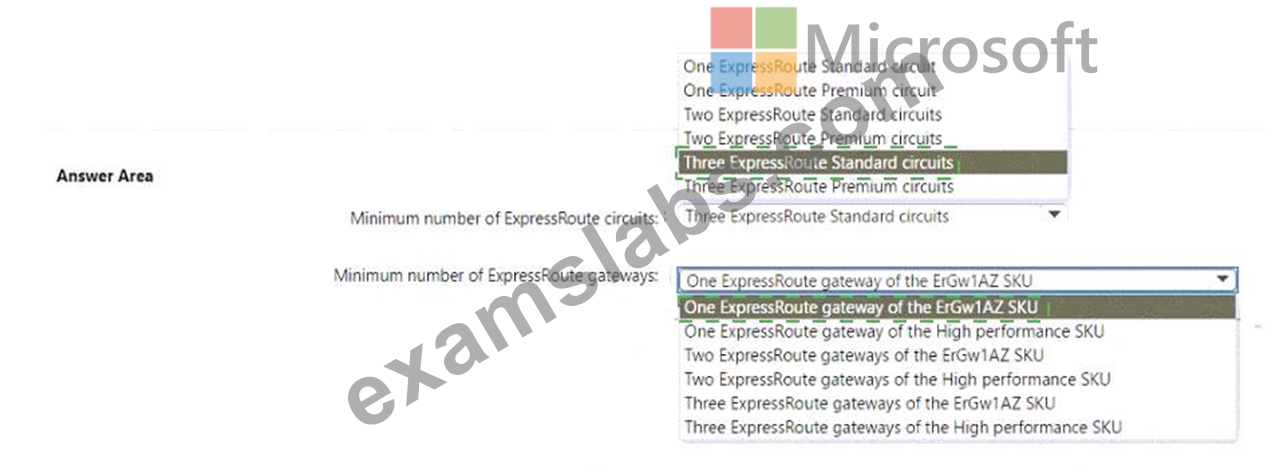
Explanation: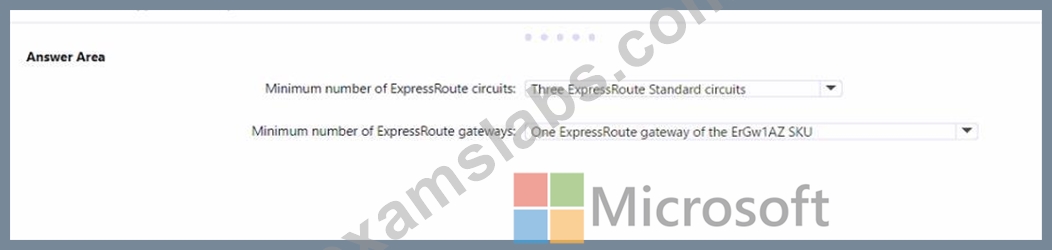
NEW QUESTION # 146
Azure Private Endpoint acts as a network interface to connect you to a service powered by Azure Private Link in a private and secure manner. Being the Private Link resource owner, which of the following actions can you perform over a private endpoint connection?
- A. Rejecting a private endpoint connection.
- B. Deleting a private endpoint connection from any state.
- C. All the above
- D. Reviewing all private endpoint connection details.
- E. Approving a private endpoint connection.
Answer: C
Explanation:
The private link resource owner can perform the below-given actions over a private endpoint connection:
Option A is incorrect. Besides reviewing all private endpoint connection details, the private link resource owner can approve, reject, and even delete a private endpoint connection.
Option B is incorrect. Besides approving a private endpoint connection, the private link resource owner can review, reject, and even delete a private endpoint connection.
Option C is incorrect. A private link resource owner can review, approve, reject and even delete a private endpoint connection.
Option D is incorrect. Besides deleting a private endpoint connection, the private link resource owner can review, approve, or even reject a private endpoint connection.
Option E is correct. A private link resource owner can perform all the given actions.
References:
https://docs.microsoft.com/en-us/azure/private-link/private-endpoint-
overview?WT.mc_id=modinfra-33046-thmaure
NEW QUESTION # 147
You have an on-premises datacenter named Site1 that contains a firewall named FW1. FW1 connects to the internet.
You have an Azure subscription that contains the resources shown in the following table.
You plan to connect Site1 to Hub1 by using a site-to-site connection.
You need to configure the site-to-site connection to FW1.
What should you create in VWAN1?
- A. a VPN site
- B. a network virtual appliance (NVA)
- C. a User VPN configuration
- D. a virtual network connection
Answer: A
NEW QUESTION # 148
You plan to configure BGP for a Site-to-Site VPN connection between a datacenter and Azure.
Which two Azure resources should you configure? Each correct answer presents a part of the solution. (Choose two.) NOTE: Each correct selection is worth one point.
- A. a local network gateway
- B. a virtual network gateway
- C. Azure Front Door
- D. Azure Application Gateway
- E. Azure Firewall
Answer: A,B
Explanation:
Reference:
https://docs.microsoft.com/en-us/azure/vpn-gateway/bgp-howto
NEW QUESTION # 149
You have an on premises web server that hosts a web app named App1 and has the following configurations:
* IP address 131.107.50.60
* FQDN server1.contoso.com
You have an Azure subscription.
You need to publish App1 by using Azure Front Door. The solution must meet the following requirements:
* Ensure that internet users can connect to App1 by using an FQDN of appl.contoso.com.
* Minimize the changes required to the configuration of Front Door if Server 1 is migrated to Azure.
What should you include in the solution? To answer, select the appropriate options in the answer area.
NOTE: Each correct selection is worth one point.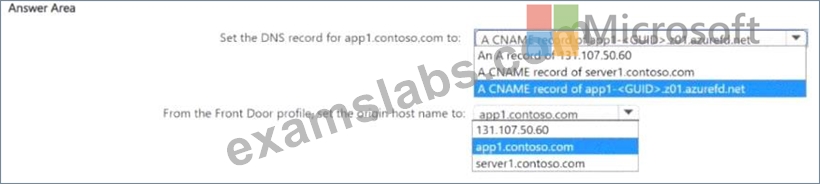
Answer:
Explanation: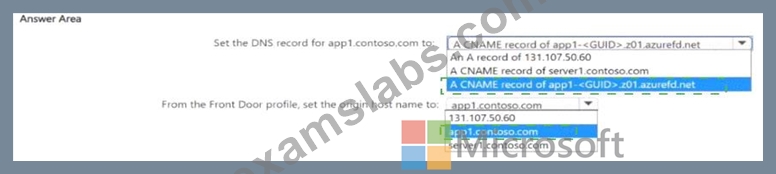
Explanation:
NEW QUESTION # 150
You have an Azure subscription that contains the public IP addresses shown in the following table.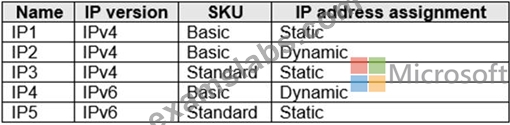
You plan to deploy a NAT gateway named NAT1.
Which public IP addresses can be used as the public IP address for NAT1?
- A. IP3 only
- B. IP1, IP3, and IP5 only
- C. IP2 and IP4 only
- D. IP5 only
- E. IP3 and IP5 only
Answer: A
Explanation:
Only static IPv4 addresses in the Standard SKU are supported. IPv6 doesn't support NAT.
Reference:
https://docs.microsoft.com/en-us/azure/virtual-network/nat-gateway/nat-overview
NEW QUESTION # 151
You have an Azure Front Door instance that provides access to a web app. The web app uses a hostname of www.contoso.com.
You have the routing rules shown in the following table.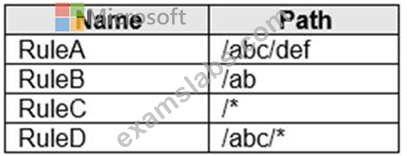
Which rule will apply to each incoming request? To answer, select the appropriate options in the answer area.
NOTE: Each correct selection is worth one point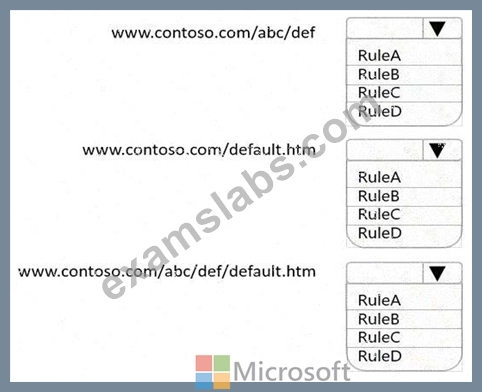
Answer:
Explanation: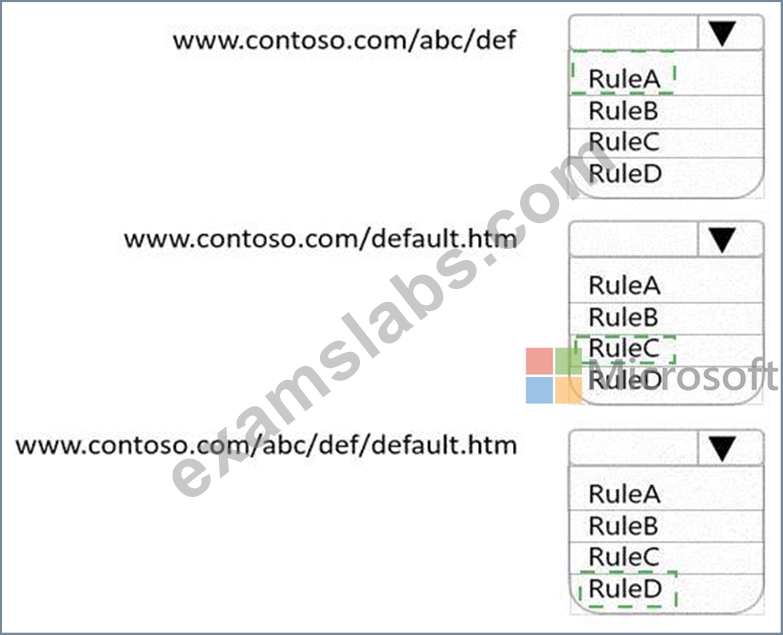
Explanation: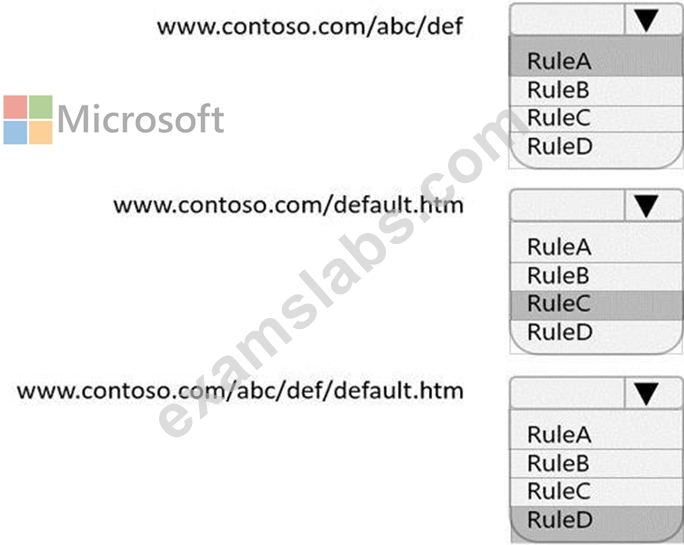
Reference:
https://docs.microsoft.com/en-us/azure/frontdoor/front-door-route-matching
NEW QUESTION # 152
You have the Azure Traffic Manager profiles shown in the following table.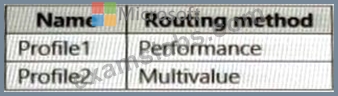
You plan to add the endpoints shown in the following table.
Which endpoints can you add to Profile2?
- A. Endpoint2 and Endpoint3 only
- B. Endpoint1 only
- C. Endpoint3 only
- D. Endpoint1 and Endpoint4 only
- E. Endpoint1, Endpoint2, Endpoint3, and Endpoint4
Answer: C
Explanation:
Multivalue traffic-routing method
The Multivalue traffic-routing method allows you to get multiple healthy endpoints in a single DNS query response. This configuration enables the caller to do client-side retries with other endpoints in case a returned endpoint being unresponsive. This pattern can increase the availability of a service and reduce the latency associated with a new DNS query to obtain a healthy endpoint.
MultiValue routing method works only if all the endpoints of type 'External' and are specified as IPv4 or IPv6 addresses. When a query is received for this profile, all healthy endpoints are returned and are subject to a configurable maximum return count.
https://docs.microsoft.com/en-us/azure/traffic-manager/traffic-manager-routing- methods#multivalue
NEW QUESTION # 153
You are configuring two network virtual appliances (NVAs) in an Azure virtual network. The NVAs will be used to inspect all the traffic within the virtual network.
You need to provide high availability for the NVAs. The solution must minimize administrative effort.
What should you include in the solution?
- A. Azure Front Door
- B. Azure Application Gateway
- C. Azure Traffic Manager
- D. Azure Standard Load Balancer
Answer: D
Explanation:
This design uses two Azure Load Balancers to expose a cluster of NVAs to the rest of the network.
https://learn.microsoft.com/en-us/azure/architecture/reference-architectures/dmz/nva-ha?tabs=cli
NEW QUESTION # 154
You have the Azure load balancer shown in the Load Balancer exhibit.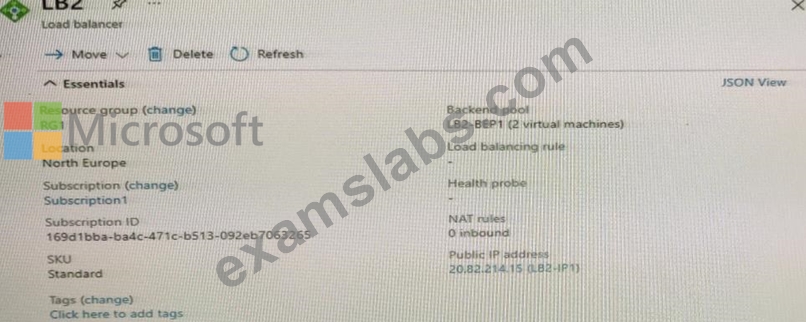
LB2 has the backend pools shown in the Backend Pools exhibit.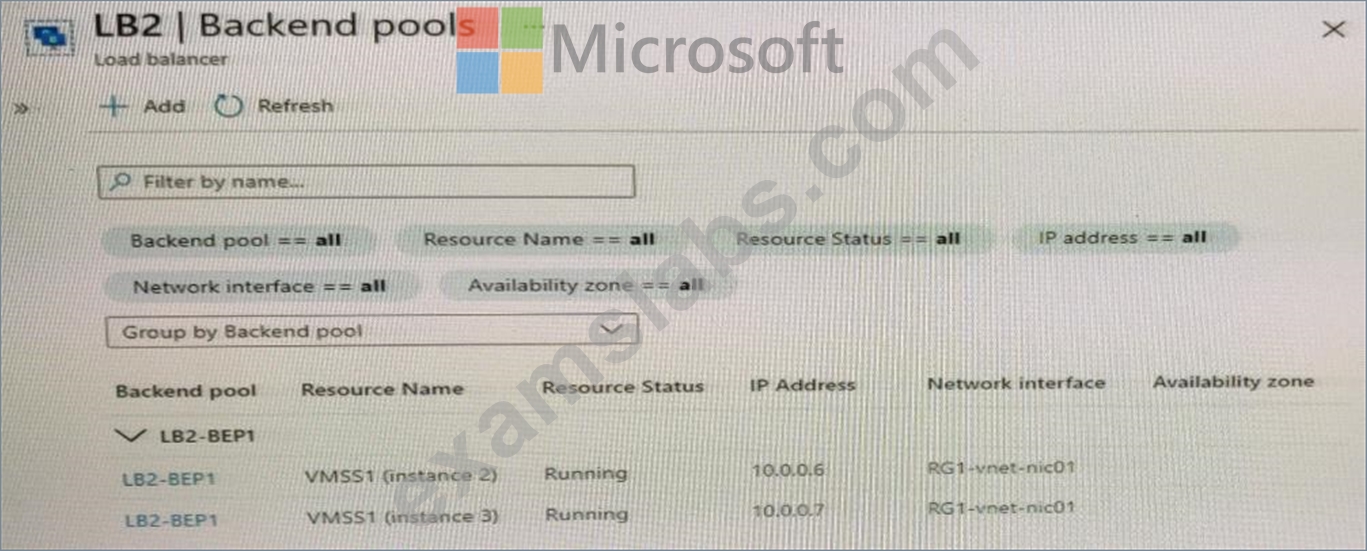
You need to ensure that LB2 distributes traffic to all the members of VMSS1.
Which two actions should you perform? Each correct answer presents part of the solution.
NOTE: Each correct selection is worth one point.
- A. Add a network interface to VMSS1.
- B. Configure a health probe.
- C. Add a public IP address to each member of VMSS1.
- D. Add a load balancing rule.
Answer: B,D
Explanation:
Reference:
https://docs.microsoft.com/en-us/azure/load-balancer/quickstart-load-balancer-standard-public-portal?tabs=option-1-create-load-balancer-standard
NEW QUESTION # 155
......
Authentic Best resources for AZ-700 Online Practice Exam: https://www.examslabs.com/Microsoft/Microsoft-Certified-Azure-Network-Engineer-Associate/best-AZ-700-exam-dumps.html
Get the superior quality AZ-700 Dumps with explanations waiting just for you, get it now: https://drive.google.com/open?id=1uG-MYxpKZkDh3Ud3cDxIxjc7NU-TNEC7