

[Dec-2025] Pass 2V0-32.24 Exam in First Attempt Updated 2V0-32.24 Exam Questions
VCP-CO 2024 Dumps 2V0-32.24 Exam for Full Questions - Exam Study Guide
VMware 2V0-32.24 Exam Syllabus Topics:
| Topic | Details |
|---|---|
| Topic 1 |
|
| Topic 2 |
|
| Topic 3 |
|
| Topic 4 |
|
NEW QUESTION # 30
In vRealize Operations, a user applies a CPU License to a custom group which has existing hosts.
How will the Virtual Machines (VMs) on the existing hosts be affected?
- A. vRealize Operations prompts the user to apply a VM license key to the VMs running.
- B. The VMs running on the hosts show a 'License is Invalid' watermark.
- C. The VMs running on the hosts are not affected.
- D. The CPU license gets converted to a CPU and VM license.
Answer: C
Explanation:
When a CPU license is applied to a custom group in vRealize Operations, it impacts the hosts but does not directly affect the Virtual Machines (VMs) running on those hosts. The license is applied at the host level, and the VMs are not impacted by this change. The VMs will continue to run as they were, and no additional VM licenses are required.
NEW QUESTION # 31
An administrator has been tasked with creating an identically configured deployment of the production vRealize Operations cluster that is currently managed by vRealize Suite Lifecycle Manager (vRSLCM).
Which four steps should the administrator complete to meet this objective? (Choose four.)
- A. Update the YAML file to replace any configuration details
- B. Create new locker SSL certificates for the new deployment
- C. Create a new vRSLCM Environment using the YAML Configuration file
- D. Export the configuration for the Production vRSLCM Environment
- E. Create new locker SSL certificates and passwords for the new deployment
- F. Create a new vRSLCM Environment using the JSON Configuration file
- G. Update the JSON file to replace any configuration details
Answer: A,D,F,G
Explanation:
Update the YAML file to replace any configuration details: The configuration details for the production vRealize Operations cluster will need to be reflected in the YAML file, which contains setup details for replication.
Create a new vRSLCM Environment using the JSON Configuration file: The environment configuration for the new deployment can be created using the exported JSON configuration file.
Update the JSON file to replace any configuration details: The exported JSON configuration file needs to be modified to ensure that it points to the new environment setup (e.g., IP addresses, FQDNs).
Export the configuration for the Production vRSLCM Environment: Exporting the existing production configuration is the first step in creating a new, identically configured deployment of vRealize Operations.
NEW QUESTION # 32
An administrator would like to monitor third-party storage array metrics in vRealize Operations.
Which three steps should the administrator take to complete this objective? (Choose three.)
- A. Download the Content Pack from VMware Marketplace
- B. Download the Management Pack from the VMware Marketplace to the local system
- C. Install and configure the Management Pack
- D. Download the PPK file from VMware Marketplace
- E. All Management Packs are installed & configured by default when installingthe vRealize Operations
- F. Verity that the Management Pack is supported for the specific vRealize Operations version/edition from the VMware Compatibility Guide
Answer: A,B,C
Explanation:
Download the Content Pack from VMware Marketplace: To monitor third-party storage arrays, you need to obtain the relevant content pack, which contains predefined dashboards, reports, and other resources.
Download the Management Pack from the VMware Marketplace to the local system: The necessary management pack, which includes the integrations required to monitor third-party storage arrays, must be downloaded from the VMware Marketplace.
Install and configure the Management Pack: After downloading, the management pack needs to be installed and configured in vRealize Operations to enable monitoring of the third-party storage array.
NEW QUESTION # 33
Forty days ago, an administrator provisioned a Virtual Machine (vm-01) in preparation for a new project. The project has now been delayed due to budgetary constraints. As part of the monthly service management checks, a second administrator executes the reclaim action on all idle virtual machines and vm-01 is listed.
The second administrator accidentally reclaims all idle virtual machines including vm-01.
What action can the administrator complete to prevent this scenario from happening again?
- A. Disable Capacity reclamation on the policy applied to new virtual machines.
- B. Create a new policy that disables the capacity reclamation on the policy and apply the policy to the parent object hosting new virtual machines.
- C. Create a dynamic group with membership based on vSphere tags so that all new virtual machines are included and then exclude the entire group from reclaim analysis.
- D. Increase the default value of the Exclude VM provisioned in the last x days setting.
Answer: D
Explanation:
To prevent virtual machines like vm-01 from being reclaimed too early, the administrator can increase the default value of the Exclude VM provisioned in the last x days setting. This ensures that newly provisioned VMs, like vm-01, will be excluded from the reclamation process for a longer period (e.g., 30, 60, or more days), preventing accidental reclamation of VMs that are still in use or under consideration for future projects.
This action directly addresses the issue of accidentally reclaiming recently provisioned virtual machines.
NEW QUESTION # 34
Which three filters can be used when adding agents to an agent group in vRealize Log Insight? (Choose three.)
- A. Logging protocol
- B. Agent type
- C. IP address
- D. Agent version
- E. Agent status
- F. Hostname
Answer: B,D,F
Explanation:
Agent type: This filter allows the administrator to group agents by their type, such as virtual, physical, or containerized agents.
Agent version: Filters agents by their version, which can be helpful in ensuring compatibility and updating agents.
Hostname: This filter groups agents based on the hostname of the machines they are installed on, providing more targeted management.
NEW QUESTION # 35
An administrator is updating a Content Pack within vRealize Log Insight which has user modifications.
What step should the administrator take to ensure the user modifications persist after the update?
- A. Export the modifications as a Content Pack and import the changes to the user profile after the update is completed.
- B. Persist user modifications is not available when updating the Content Pack.
- C. Export the modifications as a Content Pack and import the changes to the system profile after the update is completed.
- D. Update the content pack as per the standard procedure.
Answer: C
Explanation:
When updating a Content Pack in vRealize Log Insight that has user modifications, it is essential to export the custom changes (such as modified queries, dashboards, etc.) as a separate Content Pack. After the update is completed, the exported Content Pack containing the user modifications can be imported back into the system profile to ensure that the customizations persist and are not lost during the update process.
NEW QUESTION # 36
Which two types of pre-configured content are provided when deploying a content packs in vRealize Log Insight? (Choose two.)
- A. Custom scripts
- B. Reports
- C. Extracted fields
- D. Recommendation
- E. Dashboards
Answer: B,E
Explanation:
When deploying a content pack in vRealize Log Insight, the following pre-configured content is typically provided:
Dashboards: Content packs often come with pre-configured dashboards that allow users to quickly visualize log data and gain insights based on predefined queries and metrics.
Reports: Content packs may also include pre-configured reports that summarize log data, helping users quickly generate and view key information from the logs.
NEW QUESTION # 37
A vRealize Log Insight (vRLI) administrator wants to search archived logs for certain events.
What are the required steps to provide the administrator the ability to search the log messages?
- A. SSH into the NFS server, mount the archiving partition, then import the archive using CLI to vRLI appliance.
- B. SSH into the vRLI appliance, mount the archiving NFS share then import the archive using CLI.
- C. SSH into the NFS server, install vRLI tools, then import the archive using CLI from NFS share to the vRLI appliance.
- D. SSH into the vRLI appliance, install vRLI tools, then import the archive using CLI from NFS share to the vRLI appliance.
Answer: B
Explanation:
To allow the administrator to search archived logs in vRealize Log Insight (vRLI), the logs stored in an NFS share must be imported into the vRLI appliance. The correct steps involve SSHing into the vRLI appliance, mounting the NFS share where the archived logs are stored, and then using the CLI to import the archived logs into the vRLI appliance for searching. This is the standard method for handling archived log files in vRLI.
NEW QUESTION # 38
An administrator has been tasked with deploying vRealize Operations (vROps).
The requirements are:
The deployment must consume a minimal amount of cluster compute resources The deployment must be resilient against a single vROps node failure Which option would meet the requirements?
- A. Deploy two Remote Collector nodes and place them in a Collector Group
- B. Deploy vRealize Operations so that Continuous Availability (CA) can be enabled
- C. Deploy vRealize Operations as a cluster
- D. Deploy vRealize Operations as a cluster and enable High Availability (HA)
Answer: D
Explanation:
To meet the requirement of consuming minimal cluster compute resources while also being resilient against a single node failure, deploying vRealize Operations as a cluster and enabling High Availability (HA) is the best option.
NEW QUESTION # 39
Which capability of vRealize Suite Lifecycle Manager can help administrators with the use case of automating day 2 operations in a private cloud environment?
- A. Centralized log analysis for all vRealize components deployed on-premises.
- B. Proactive monitoring and automated remediation of Workspace ONE Access database consistency problems.
- C. Management of configurations, certificates, licenses, passwords, and users.
- D. Proactive findings and recommendations delivered on-demand.
Answer: C
Explanation:
vRealize Suite Lifecycle Manager (vRSLCM) offers a range of features to manage the lifecycle of vRealize Suite components. For automating day 2 operations in a private cloud environment, the capability of managing configurations, certificates, licenses, passwords, andusers is essential. This allows administrators to streamline the ongoing management and maintenance of the cloud environment, which includes tasks like updating licenses, managing user access, and configuring system settings, thus automating several operational aspects of the environment.
NEW QUESTION # 40
Refer to the exhibit.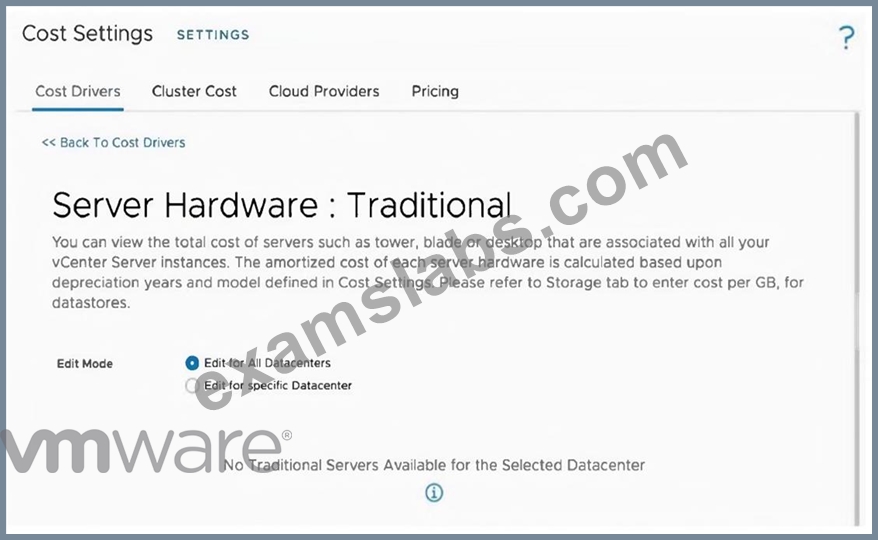
An administrator is tasked to manually upload the cost drivers of all the hosts, to obtain cost calculations accurate for their datacenter. However, when the administrator tries to update the cost drivers, the message displayed on the exhibit is shown.
What is the cause of this message?
- A. Reference database is being used.
- B. Cost drivers must be established on a per Datacenter basis.
- C. Cost calculation process is running at this moment.
- D. All hosts are in vSAN enabled clusters.
Answer: B
Explanation:
The message in the exhibit indicates that no "Traditional Servers" are available for the selected datacenter, which means the cost drivers have not been configured for that specific datacenter. In vRealize Suite, cost drivers must be set up on a per-datacenter basis, and the administrator needs to select the appropriate datacenter to configure and upload the cost drivers accordingly.
NEW QUESTION # 41
An administrator has been tasked to deploy vRealize Operations. The corporate policy states that DHCP should be used whenever supported.
Which two types of node support DHCP? (Choose two.)
- A. Worker Node
- B. Primary Node
- C. Remote Collector
- D. Data Node
- E. Replica Node
Answer: C,D
Explanation:
Remote Collector: These nodes can use DHCP to obtain their IP addresses, which is useful in environments where static IPs are not preferred for non-primary infrastructure.
Data Node: Data nodes can also be configured with DHCP, simplifying IP management in large deployments.
NEW QUESTION # 42
When using vRealize Lifecycle Manager to capture content from a vRealize Operations endpoint, which three statements are correct regarding the content sync? (Choose three.)
- A. Select the "Get latest" content option to retrieve the content, before the initial sync.
- B. An auto refresh of content list runs in the background every 15 minutes.
- C. The Ul retrieves the content every time from the endpoint when opening the endpoint.
- D. The Ul retrieves the content from the endpoint when listing the content for the first time.
- E. Select the "Get latest" content option to retrieve the content in between automatic sync timers.
- F. An auto refresh of content list runs in the background every 30 minutes.
Answer: D,E,F
Explanation:
An auto refresh of content list runs in the background every 30 minutes: vRealize Lifecycle Manager automatically refreshes the content list from the vRealize Operations endpoint every 30 minutes to ensure the most current content is displayed.
Select the "Get latest" content option to retrieve the content in between automatic sync timers: If the administrator wants to manually sync and get the latest content between the auto-refresh intervals, they can select the "Get latest" option.
The UI retrieves the content from the endpoint when listing the content for the first time: When accessing the content for the first time, the UI will retrieve the content directly from the endpoint to populate the list.
NEW QUESTION # 43
An administrator has been tasked with deploying vRealize Operations using a new vRealize Suite Lifecycle Manager (vRSLCM) instance that has already been configured with VMware Identity Manager.
Which item must be configured in vRSLCM before the administrator can complete the deployment?
- A. A registered authentication provider
- B. A valid license for vRealize Suite Lifecycle Manager
- C. A valid license for vRealize Suite
- D. Outbound notifications settings
Answer: A
Explanation:
Before completing the deployment of vRealize Operations through vRSLCM, an authentication provider must be registered. This step ensures that users can authenticate using appropriate credentials, which is especially important when VMware Identity Manager is already configured. Without a registered authentication provider, users would not be able to access the environment or perform necessary tasks.
NEW QUESTION # 44
An administrator is deploying vRealize Log Insight and needs to choose the most performant disk format option.
Which option should the administrator choose?
- A. Deploy vRealize Log Insight using the Thick Provision Lazy Zeroed disk format.
- B. Deploy vRealize Log Insight using the Thin Provision disk format.
- C. Deploy vRealize Log Insight using Raw Disk Mapping.
- D. Deploy vRealize Log Insight using the Thick Provision Eager Zeroed disk format.
Answer: D
Explanation:
The most performant disk format for vRealize Log Insight is Thick Provision Eager Zeroed. This format provides better performance because the entire disk is allocated at the time of creation and is immediately zeroed out, which eliminates the overhead of allocating space during runtime and ensures faster read/write operations.
NEW QUESTION # 45
Which three guest information properties are collected for all objects created by the OS and Application Monitoring management pack? (Choose three.)
- A. OS Version
- B. Hostname
- C. BIOS UUID
- D. OS Build Number
- E. MAC Address
- F. IP Address
Answer: A,D,F
Explanation:
The OS and Application Monitoring management pack in vRealize Operations collects various guest information properties for all objects, including:
OS Build Number: The version/build of the operating system running on the guest.
OS Version: The version of the operating system installed on the guest.
IP Address: The network IP address assigned to the guest.
NEW QUESTION # 46
Which option represents a use case of vRealize Log Insight?
- A. Auto-scale applications as a response of log pattern identification.
- B. Intelligently group log sources standard output to rapidly understand issues.
- C. Analyze communications between applications to facilitate micro-segmentation.
- D. Evaluate the historical utilization of resources to generate a projection of the future workload.
Answer: B
Explanation:
vRealize Log Insight is primarily used for log management and analytics, helping administrators efficiently aggregate, search, and analyze log data from various sources. Chosen option describes the core functionality of vRealize Log Insight, where it intelligently groups and aggregates log sources to help users quickly understand issues, identify patterns, and troubleshoot problems effectively.
NEW QUESTION # 47
An administrator needs to change the password for the admin user account on vRealize Operations.
Which two methods can the administrator use to complete this task? (Choose two.)
- A. Log in to each node via SSH and use the appropriate script to reset the admin user account password
- B. Log in to the vRealize Operations admin UI as the admin user and use the change password functionality
- C. Log in to vRealize Suite Lifecycle Manager and use the rotate password functionality
- D. Log in to the vRealize Operations admin UI as the admin user, take the cluster offline and use the change password functionality
- E. Log in to the Primary node via SSH and use the appropriate command to reset the admin user account password
Answer: A,E
Explanation:
To change the password for the admin user account in vRealize Operations, these methods can be used:
Log in to the Primary node via SSH and use the appropriate command to reset the admin user account password: This method allows the administrator to directly reset the admin password on the primary node via SSH using command-line utilities specific to vRealize Operations.
Log in to each node via SSH and use the appropriate script to reset the admin user account password: In a multi-node environment, the password reset might need to be performed on each node using a script to ensure that the new password is applied across all nodes in the cluster.
NEW QUESTION # 48
An administrator has been tasked with implementing a solution to meet the following requirements:
Provide monitoring and predictive analytics across enterprise database solutions Provide monitoring and predictive analytics across enterprise networking solutions Provide performance data for common enterprise application solutions Provide performance data for VMware Tanzu Application Service Present all collected data to administrators within a single portal Provide vendor support for the deployed solution Which solution could help the administrator complete this task?
- A. vRealize Operations and vRealize True Visibility Suite
- B. vRealize Log Insight and vRealize Suite Lifecycle Manager
- C. vRealize Operations using a community created management pack
- D. vRealize Operations using the Endpoint Operations Agent
Answer: A
Explanation:
vRealize Operations, combined with thevRealize True Visibility Suite, provides comprehensive monitoring and predictive analytics across various enterprise solutions such as databases, networking, applications, and VMware Tanzu Application Service. TheTrue Visibility Suiteincludes a wide range of management packs for different technologies, which allows the collection and visualization ofperformance data for these enterprise solutions in a single portal. Additionally, the suite offers vendor support, ensuring reliable integration and support for the deployed solution.
NEW QUESTION # 49
When setting up the vRealize Log Insight integration within vRealize Operations what do administrators configure within vRealize Operations?
- A. The vRealize Log Insight collector group instance
- B. The vRealize Log Insight content pack
- C. The vRealize Log Insight troubleshootingdashboard
- D. The vRealize Log Insight management pack
Answer: D
Explanation:
When setting up vRealize Log Insight integration within vRealize Operations, administrators configure the vRealize Log Insight management pack in vRealize Operations. This management pack allows vRealize Operations to integrate with vRealize Log Insight, enabling the collection and analysis of log data from vRealize Log Insight within the vRealize Operations platform. It provides enhanced visibility and monitoring for logs, allowing users to correlate performance data with log data.
NEW QUESTION # 50
Which VMware product provides continuous performance optimization, efficient capacity and cost management, intelligent remediation, and integrated compliance as a subscription based service?
- A. vRealize Log Insight
- B. vRealize Operations
- C. vRealize Log Insight Cloud
- D. vRealize Operations Cloud
Answer: D
Explanation:
vRealize Operations Cloud is a subscription-based service that delivers continuous performance optimization, efficient capacity and cost management, intelligent remediation, and integrated compliance. It leverages the cloud to provide these features, which allow organizations to manage and optimize their environments more effectively and with flexibility.
NEW QUESTION # 51
......
Authentic Best resources for 2V0-32.24 Online Practice Exam: https://www.examslabs.com/VMware/VCP-CO-2024/best-2V0-32.24-exam-dumps.html
Get the superior quality 2V0-32.24 Dumps with explanations waiting just for you, get it now: https://drive.google.com/open?id=18ug91c8ePbNKjPySJlGwphQLM4E-qb_J