

Cisco 200-301 Real Exam Questions and Answers FREE
Exam Dumps 200-301 Practice Free Latest Cisco Practice Tests
NEW QUESTION # 19
What are two reasons a network administrator would use CDP? (Choose two.)
- A. to obtain VLAN information from directly connected switches
- B. to determine the status of network services on a remote device
- C. to determine the status of the routing protocols between directly connected routers
- D. to verify Layer 2 connectivity between two devices when Layer 3 fails
- E. to obtain the IP address of a connected device in order to telnet to the device
- F. to verify the type of cable interconnecting two devices
Answer: D,E
Explanation:
Section: Network Access
NEW QUESTION # 20
What are two characteristics of a public cloud Implementation? (Choose two.)
- A. It supports network resources from a centralized third-party provider and privately-owned virtual resources
- B. It Is a data center on the public Internet that maintains cloud services for only one company.
- C. It enables an organization to fully customize how It deploys network resources.
- D. It provides services that are accessed over the Internet.
- E. It is owned and maintained by one party, but it is shared among multiple organizations.
Answer: A,D
Explanation:
Private cloud is cloud infrastructure operated solely for a single organization, whether managed internally or by a third party, and hosted either internally or externally.
Most public-cloud providers offer direct-connection services that allow customers to securely link their legacy data centers to their cloud-resident applications.
NEW QUESTION # 21 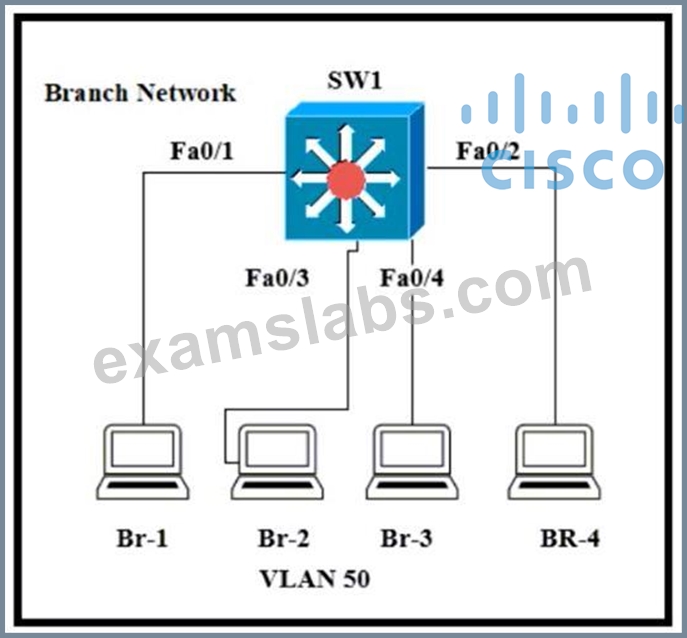
Refer to the exhibit. The entire MAC address table for SW1 is shown here:
SW1#show mac-address-table
Mac Address Table
Vlan Mac Address Type Ports
000c.8590.bb7d DYNAMIC Fa0/1
010a.7a17.45bc DYNAMIC FaO/3
7aa7.4037.8935 DYNAMIC FaO/4
SW1#
What does SW1 do when Br-4 sends a frame to Br-2?
- A. It inserts the source MAC address and port into the forwarding table and forwards the frame to Br-2.
- B. It floods the frame out of all ports except on the port where Br-2 is connected.
- C. It maps the Layer 2 MAC address for FaO/3 to the Layer 3 IP address and forwards the frame.
- D. It performs a lookup in the MAC address table for Br-4 and discards the frame due to a missing entry.
Answer: A
NEW QUESTION # 22
Which two actions influence the EIGRP route selection process? (Choose two)
- A. The router calculates the feasible distance of all paths to the destination route
- B. The router calculates the best backup path to the destination route and assigns it as the feasible successor.
- C. The router calculates the reported distance by multiplying the delay on the exiting Interface by 256.
- D. The router must use the advertised distance as the metric for any given route
- E. The advertised distance is calculated by a downstream neighbor to inform the local router of the bandwidth on the link
Answer: A,B
Explanation:
The reported distance (or advertised distance) is the cost from the neighbor to the destination. It is calculated from the router advertising the route to the network. For example in the topology below, suppose router A & B are exchanging their routing tables for the first time. Router B says "Hey, the best metric (cost) from me to IOWA is 50 and the metric from you to IOWA is 90" and advertises it to router A.
Router A considers the first metric (50) as the Advertised distance. The second metric (90), which is from NEVADA to IOWA (through IDAHO), is called the Feasible distance.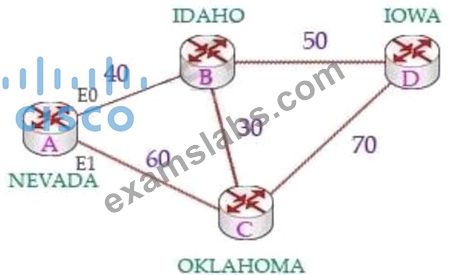
The reported distance is calculated in the same way of calculating the metric. By default (K1 = 1, K2 = 0, K3 = 1, K4 = 0, K5 = 0), the metric is calculated as follows:
NEW QUESTION # 23
Refer to the exhibit.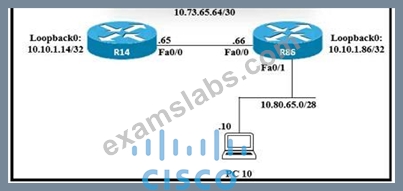
Router R14 is in the process of being configured. Which configuration must be used to establish a host route to PC 10?
- A. ip route 10.73.65.66 0.0.0.255 10.80.65.10
- B. ip route 10.8065.10 255.255.255.255 10.73.65.66
- C. ip route 10.80.65.10 255.255.255.254 10.80.65.1
- D. ip route 1073.65.65 255.0.0.0 10.80.65.10
Answer: B
NEW QUESTION # 24
Which cable type must be used to interconnect one switch using 1000 BASE-SX GBiC modules and another switch using 1000 BASE-SX SFP modules?
- A. LC to SC
- B. SC to SC
- C. LC to LC
- D. SC t ST
Answer: C
NEW QUESTION # 25
Refer to the exhibit.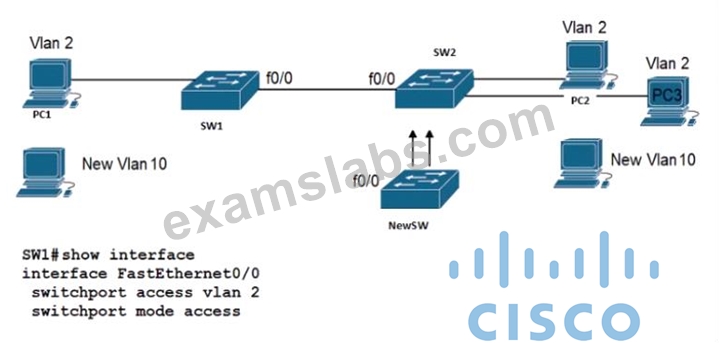
An engineer is configuring a new Cisco switch NewSW, to replace SW2 The details have been provided
* Switches SW1 and SW2 are third-party devices without support for trunk ports
* The existing connections must be maintained between PC1 PC2 and PC3
* Allow the switch to pass traffic from future VLAN 10. Which configuration must be applied?
A)
B)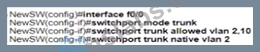
C)
D)
- A. Option B
- B. Option D
- C. Option C
- D. Option A
Answer: A
NEW QUESTION # 26
Refer to the exhibit.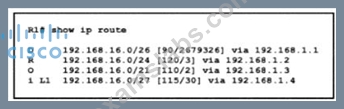
Which route does R1 select for traffic that is destined to 192 168.16.2?
- A. 192.168.16.0/24
- B. 192.168 26.0/26
- C. 192.168.16.0/27
- D. 192.168.16.0/21
Answer: B
NEW QUESTION # 27
What feature uses a random time to re-sent a frame?
- A. CSMA/CD
- B. CSMA/CA
Answer: A
NEW QUESTION # 28
Refer to the exhibit.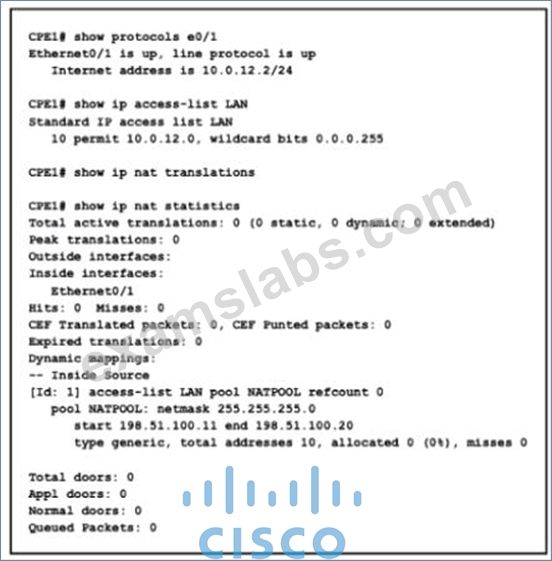
What is the next step to complete the implementation for the partial NAT configuration shown?
- A. Apply the ACL to the pool configuration
- B. Modify the access list for the internal network on e0/1
- C. Configure the NAT outside interface
- D. Reconfigure the static NAT entries that overlap the NAT pool
Answer: D
NEW QUESTION # 29
Refer to the exhibit.
Host A switch interface is configured in VLAN 2. Host D sends a unicast packet destined for the IP address of host A.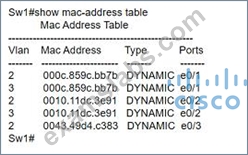
What does the switch do when it receives the frame from host D?
- A. It drops the frame from the MAC table of the switch.
- B. It creates a broadcast storm.
- C. It floods the frame out of every port except the source port.
- D. It shuts down the source port and places It In err-disable mode.
Answer: D
NEW QUESTION # 30
Refer to the exhibit.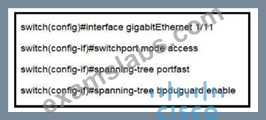
What is the result if Gig1/11 receives an STP BPDU?
- A. The port transitions to the root port
- B. The port goes into error-disable state
- C. The port transitions to STP blocking
- D. The port immediately transitions to STP forwarding.
Answer: B
NEW QUESTION # 31
Drag and drop each characteristic of device-management technologies from the left onto the deployment type on the right.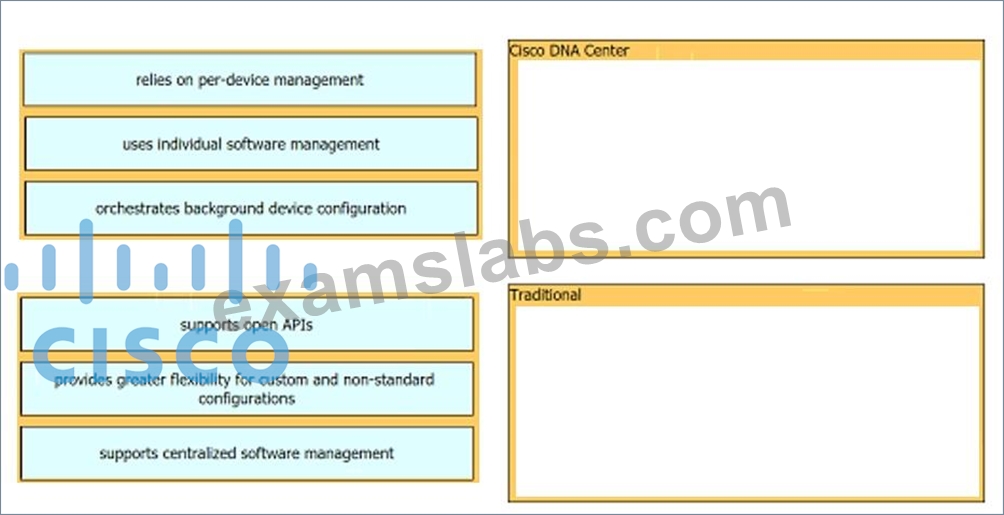
Answer:
Explanation: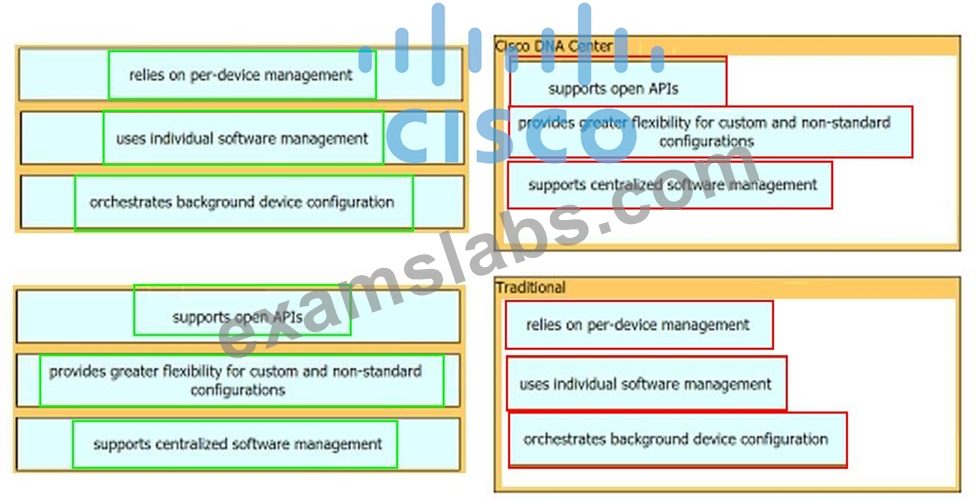
NEW QUESTION # 32
Which information is used to install the best route to a destination in IP routing table?
- A. the interface number
- B. the tunnel ID
- C. the prefix length
- D. the autonomous system
Answer: C
NEW QUESTION # 33
Refer to the exhibit.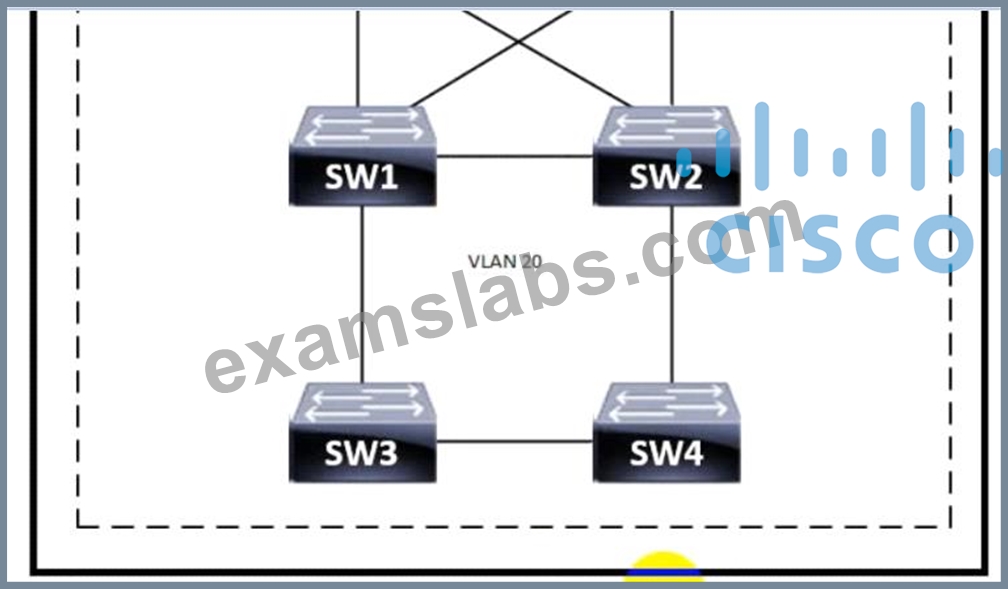
Which switch becomes the root of a spanning tree for VLAN 20 if all li links are of equal speed?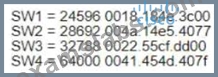
- A. SW4
- B. SW1
- C. SW3
- D. SW2
Answer: C
NEW QUESTION # 34
......
Verified 200-301 Exam Dumps Q&As - Provide 200-301 with Correct Answers: https://www.examslabs.com/Cisco/CCNA/best-200-301-exam-dumps.html
200-301 Exam Questions | Real 200-301 Practice Dumps: https://drive.google.com/open?id=10_ZHOcm2Lqp2xrdnUl529UHZx1CDs1VI