

Changing the Concept of NSE4_FGT_AD-7.6 Exam Preparation 2026
Getting NSE4_FGT_AD-7.6 Certification Made Easy! Get professional help from our NSE4_FGT_AD-7.6 Dumps PDF
NEW QUESTION # 49
What are two features of collector agent advanced mode? (Choose two.)
- A. Advanced mode uses the Windows convention -NetBios: Domain\Username.
- B. In advanced mode, FortiGate can be configured as an LDAP client and group filters can be configured on FortiGate.
- C. Advanced mode supports nested or inherited groups.
- D. In advanced mode, security profiles can be applied only to user groups, not individual users.
Answer: B,C
Explanation:
Also, advanced mode supports nested or inherited groups; that is, users can be members of subgroups that belong to monitored parent groups.
In advanced mode, you can configure FortiGate as an LDAP client and configure the group filters on FortiGate. You can also configure group filters on the collector agent.
NEW QUESTION # 50
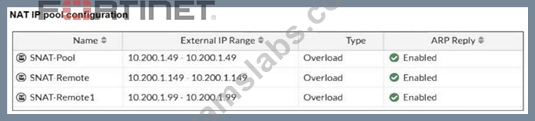
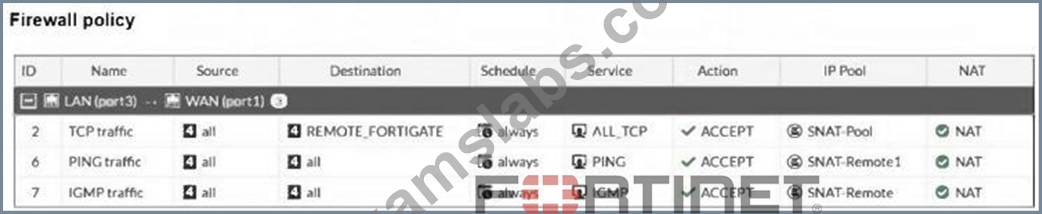
Refer to the exhibits. The exhibits show a diagram of a FortiGate device connected to the network, as well as the IP pool configuration and firewall policy objects.
The WAN (port1) interface has the IP address 10.200.1.1/24. The LAN (port3) interface has the IPaddress 10.0.1.254/24.
Which IP address will be used to source NAT (SNAT) the traffic, if the user on Local-Client (10.0.1.10) pings the IP address of Remote-FortiGate (10.200.3.1)?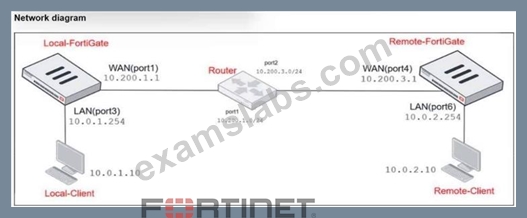
- A. 10.200.1.99
- B. 10.200.1.1
- C. 10.200.1.49
- D. 10.200.1.149
Answer: A
Explanation:
All_TCP doesn't include ICMP. So you would match rule ID 2, in which uses IP Poop remote 1.
NEW QUESTION # 51
An administrator wants to configure dead peer detection (DPD) on IPsec VPN for detecting dead tunnels. The requirement is that FortiGate sends DPD probes only when there is no inbound traffic.
Which DPD mode on FortiGate meets this requirement?
- A. Enabled
- B. On Idle
- C. Disabled
- D. On Demand
Answer: D
Explanation:
Disable: Disable Dead Peer Detection.
On-idle: Trigger Dead Peer Detection when no IPsec traffic is received.
On-demand: Trigger Dead Peer Detection when no IPsec traffic is received AND FortiGate has been sending IPsec traffic. On-demand is the default setting.
NEW QUESTION # 52
Refer to the exhibit, which shows an SD-WAN zone configuration on the FortiGate GUI.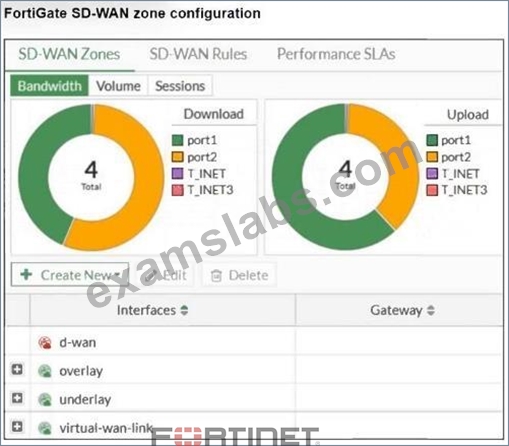
Based on the exhibit, which statement is true?
- A. The underlay zone contains port1 and port2.
- B. The d-wan zone cannot be deleted.
- C. The d-wan zone contains no member.
- D. The virtual-wan-link zone contains no member.
Answer: C
Explanation:
The "d-wan" zone in FortiGate SD-WAN configuration is the default SD-WAN zone created when SD- WAN is enabled. This zone contains all the interfaces assigned to SD-WAN and is essential for the functionality of the SD-WAN feature. The "d-wan" zone cannot be deleted because it is required for SD-WAN operations. Option A is incorrect because the underlay zone does not contain port1.
NEW QUESTION # 53
Refer to the exhibit. Why did FortiGate drop the packet?
- A. It matched the default implicit firewall policy.
- B. It matched an explicitly configured firewall policy with the action DENY.
- C. The next-hop IP address is unreachable.
- D. It failed the RPF check.
Answer: A
Explanation:
The debug trace output shows that the packet was "Denied by forward policy check (policy 0)." In FortiGate, policy ID 0 corresponds to the default implicit deny policy. This means that if a packet does not match any configured firewall policies, it is denied by the default implicit policy.
NEW QUESTION # 54
Refer to the exhibits. The exhibits show a diagram of a FortiGate device connected to the network, as well as the IP pool configuration and firewall policy objects.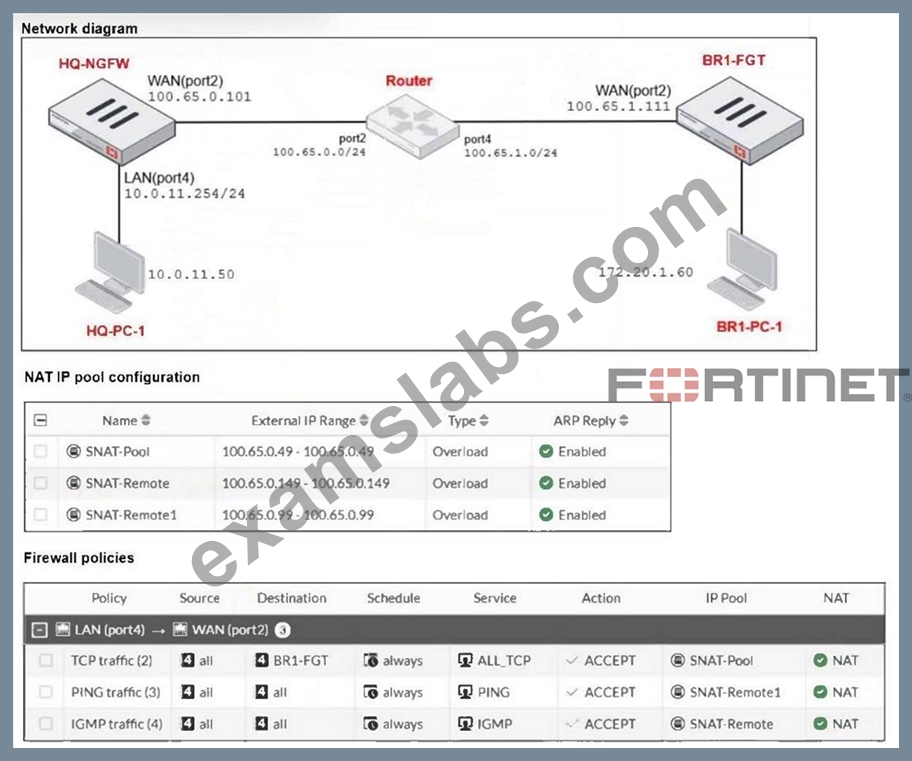
The WAN (port2) interface has the IP address 100.65.0.101/24. The LAN (port4) interface has the IP address 10.0.11.254/24. Which IP address will be used to source NAT (SNAT) the traffic, if the user on HQ-PC-1 (10.0.11.50) pings the IP address of BR-FGT (100.65.1.111)
- A. 100.65.0.149
- B. 100.65.0.101
- C. 100.65.0.99
- D. 100.65.0.49
Answer: C
Explanation:
The ping traffic policy uses the IP pool named SNAT-Remote1, which has the external IP range
100.65.0.99. Therefore, traffic matching this policy (ping from HQ-PC-1 to BR1-FGT) will use
100.65.0.99 for source NAT.
NEW QUESTION # 55
Refer to the exhibit. Which two statements about the FortiGuard connection are true? (Choose two.)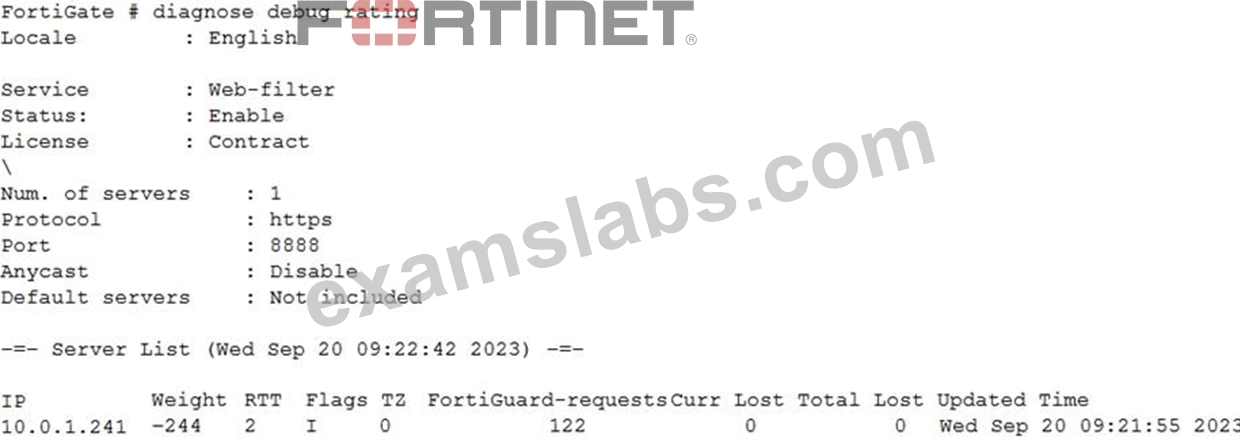
- A. FortiGate identified the FortiGuard Server using DNS lookup.
- B. You can configure unreliable protocols to communicate with FortiGuard Server.
- C. FortiGate is using the default port for FortiGuard communication.
- D. The weight increases as the number of failed packets rises.
Answer: A,D
Explanation:
FortiGate identified the FortiGuard Server using DNS lookup → The server is shown with a private IP (10.0.1.241), which indicates FortiGate resolved it via DNS or explicit override rather than using default FortiGuard anycast servers.
The weight value reflects server reliability. It decreases with good performance and increases as packet loss or failures rise, meaning higher weight indicates more failures.
NEW QUESTION # 56
When configuring a FortiGate in a multi-WAN setup, why would an administrator enable session preservation on an interface?
- A. To make sure all sessions without source NAT enabled always use the primary WAN link
- B. To improve security by forcing users to authenticate again when the WAN link changes
- C. To allow the FortiGate to dynamically change interfaces for all active sessions when a WAN link fails
- D. To ensure that existing SSL VPN connections remain on the same interface even if route changes occur
Answer: D
Explanation:
Session preservation keeps active sessions, such as SSL VPNs, tied to the original interface to prevent disruption when WAN routes change.
NEW QUESTION # 57
An administrator configured a FortiGate device to act as a collector for agentless polling mode.
What must the administrator add to the FortiGate device to retrieve AD user group information?
- A. LDAP server
- B. TACACS server
- C. Keycloak server
- D. RADIUS server
Answer: A
Explanation:
In agentless polling mode, FortiGate directly queries Active Directory to obtain user and group information. To do this, the administrator must configure an LDAP server on the FortiGate, which allows it to retrieve user group membership details from AD.
NEW QUESTION # 58
You have configured the FortiGate device for FSSO. A user is successful in log-in to windows, but their access to the internet is denied.
What should the administrator check first?
- A. The FortiGate firewall policy settings for SSL decryption.
- B. Whether the user is assigned to the correct AD group.
- C. The windows event viewer for failed login attempts.
- D. The FortiGate FSSO active users list for user's IP address.
Answer: D
Explanation:
Checking the active users list verifies if FortiGate correctly associates the user with their IP address, ensuring proper policy enforcement for internet access.
NEW QUESTION # 59
What are two features of FortiGate FSSO agentless polling mode? (Choose two.)
- A. FortiGate uses the SMB protocol to read the event viewer logs from the DCs.
- B. FortiGate directs the collector agent to use a remote LDAP server.
- C. FortiGate uses the AD server as the collector agent.
- D. FortiGate does not support workstation check.
Answer: A,C
Explanation:
FortiGate uses the SMB protocol to read the event viewer logs from the DCs → In agentless polling mode, FortiGate connects directly to the AD domain controllers using SMB to collect logon events.
FortiGate uses the AD server as the collector agent → There is no external FSSO collector; instead, the FortiGate itself polls the AD servers, effectively treating them as the source of logon information.
NEW QUESTION # 60
A remote user reports slow SSL VPN performance and frequent disconnections. The user is located in an area with poor internet connectivity.
What setting should the administrator adjust to improve the user's experience?
- A. Change the SSL VPN port to a non-standard port.
- B. Configure the DTLS timeout to accommodate high-latency connections.
- C. Enable split tunneling to reduce VPN traffic.
- D. Increase the session timeout for inactive sessions.
Answer: B
Explanation:
Adjusting the DTLS timeout helps maintain SSL VPN stability and performance in environments with poor or high-latency internet connectivity by allowing more time for packet retransmissions before dropping the connection.
NEW QUESTION # 61
Refer to the exhibits. An administrator configured the Web Filter Profile to block access to all social networking sites except Facebook. However, when users try to access Facebook.com, they are redirected to a FortiGuard web filtering block page.
Based on the exhibits, which configuration change must the administrator make to allow Facebook while blocking all other social networking sites?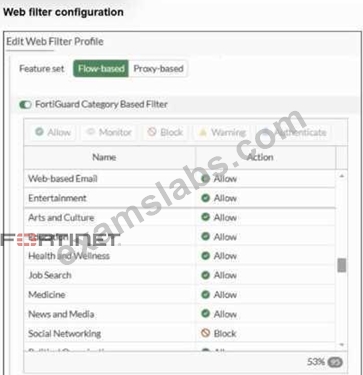
- A. Change the Feature set of Web Filter Profile as Proxy-based.
- B. Change the type as Simple in the Static URL Filter section.
- C. Set the Social Networking action as warning in the FortiGuard Category Based Filter.
- D. Set the Action as Exempt for www.facebook.com
in the Static URL Filter.
Answer: D
NEW QUESTION # 62
Which three statements about SD-WAN performance SLAs are true? (Choose three.)
- A. They monitor the state of the FortiGate device.
- B. They rely on session loss and jitter.
- C. They can be measured actively or passively.
- D. All the SLAtargets can be configured.
- E. They are applied in a SD-WAN rule lowest cost strategy.
Answer: B,C,D
Explanation:
SD-WAN SLAs monitor metrics like packet loss and jitter to evaluate link performance. SLA measurements can be performed using active probing or passive monitoring. Administrators can configure all SLA target parameters to define performance criteria.
NEW QUESTION # 63
Which two statements about the Security Fabric rating are true? (Choose two.)
- A. The Security Posture category provides PCI compliance results.
- B. The root FortiGate provides executive summaries of all the FortiGate devices in the Security Fabric.
- C. Security Rating Insights are available only in the Security Rating page.
- D. A license is required to obtain an executive summary in the Security Rating section.
Answer: B,D
Explanation:
A license is required to obtain an executive summary in the Security Rating section → Without the license, only limited Security Fabric rating details are shown.
The root FortiGate aggregates and provides executive summaries for all FortiGate devices in the Security Fabric, giving a consolidated security posture overview.
NEW QUESTION # 64
......
NSE4_FGT_AD-7.6 Exam Crack Test Engine Dumps Training With 100 Questions: https://www.examslabs.com/Fortinet/Fortinet-NSE-4/best-NSE4_FGT_AD-7.6-exam-dumps.html